Best Quiz Funnel Tools for Ecommerce and How to Integrate Them with Your Stack

Quiz funnels have become one of the most effective tools for ecommerce brands looking to improve product discovery, increase conversions, and collect valuable customer data. Instead of relying on static product pages or filters, businesses are now using interactive experiences to guide users toward the right purchase.
For many online stores, the challenge is not attracting traffic, but helping visitors make decisions. When users don’t immediately find what they’re looking for, they leave. In this article, we’ll review the best quiz funnel tools for ecommerce, explore their key features and differences, and show how to integrate them into your marketing stack to automate workflows and improve performance.
Introduction to Quiz Funnel Tools
Quiz funnel tools help ecommerce businesses create interactive experiences that guide customers toward the right product.
Instead of browsing through dozens or hundreds of items, users answer a few simple questions and receive tailored recommendations. This approach works particularly well in industries where personalization matters, such as skincare, supplements, fashion, and home goods.
Below is an overview of several popular ecommerce quiz tools, along with their positioning and typical use cases.
Quizell
Source: quizell.com
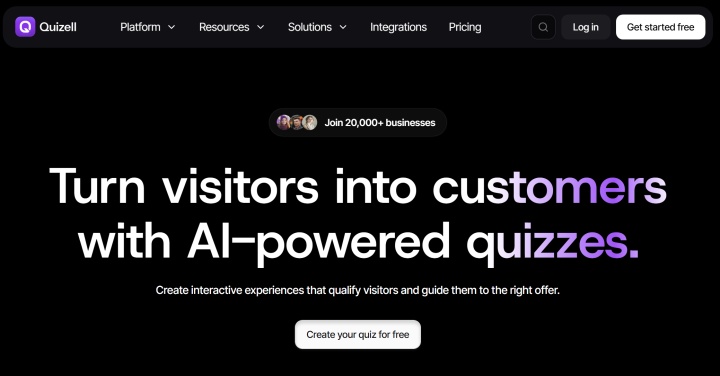
Quizell is a quiz funnel platform built specifically for ecommerce brands that want to combine personalization, automation, and AI-driven optimization.
Beyond standard quiz functionality, Quizell integrates AI across the entire funnel. It can generate quiz structures, questions, and copy based on business goals, helping teams launch faster without starting from scratch.
The platform also supports real-time optimization. Instead of manually editing quizzes, teams can adjust layouts, flows, or messaging using natural language inputs, making iteration significantly faster.
Another key capability is AI-powered product matching. Rather than relying only on static rules, recommendations can be refined based on user inputs and patterns, improving relevance and conversion rates.
Quizell is particularly useful for ecommerce teams that want to move beyond basic quizzes and build fully automated, high-performing quiz funnels.
Octane AI
Octane AI is a quiz platform designed primarily for Shopify stores. It focuses on personalization and customer data collection through quizzes and conversational experiences.
The platform offers pre-built templates and native Shopify integration, making it relatively quick to launch. It is commonly used by brands looking for a straightforward solution to add quizzes to their storefront.
Typeform
Typeform is a general-purpose tool for creating forms, surveys, and quizzes. While not built specifically for ecommerce, it is often used for interactive experiences.
Its main strength is its user-friendly and visually clean interface, which encourages completion. However, it may require additional setup when used for product recommendations.
Outgrow
Outgrow is an interactive content platform that supports quizzes, calculators, and assessments.
It offers a wide range of templates and customization options, making it suitable for marketing teams experimenting with different formats. It is often used for lead generation campaigns rather than strictly ecommerce-focused funnels.
Core Functionality
When comparing ecommerce quiz tools, it’s important to understand how they support real marketing workflows.
Most platforms include the following capabilities:
- Quiz creation. Visual builders allow teams to create quizzes without technical skills. Templates and reusable components help speed up the process.
- Conditional logic. It ensures that each user sees relevant questions based on their previous answers. This is essential for accurate personalization.
- Product recommendations. Answers are mapped to products or collections, allowing the quiz to deliver tailored recommendations at the end.
- Data collection. Each response provides insight into customer preferences, needs, and intent. This data can be used for segmentation and targeting.
- Integrations. The ability to connect quiz tools with other platforms is critical. Without integrations, much of the collected data remains unused.
Key Differences
Although these tools serve similar purposes, they differ in how they approach personalization and automation.
Ease of use
Some tools prioritize simplicity and design, while others offer more advanced features for customization and logic.
Ecommerce specialization
Platforms like Quizell and Octane AI are built specifically for ecommerce use cases, while others are more general-purpose.
Personalization depth
The level of logic and product mapping varies, which directly affects the accuracy of recommendations.
Integration capabilities
Some tools offer limited native integrations, while others rely on external platforms to connect with CRMs, messaging tools, and other services.
AI capabilities
One of the most important differences between modern quiz funnel tools is how they use AI. Some platforms offer limited AI features, such as generating questions or copy. Others are starting to integrate AI more deeply into the entire funnel experience.
More advanced tools use AI to:
- Generate quiz structures based on business goals.
- Optimize flows and messaging dynamically.
- Improve product recommendations over time.
- Reduce manual setup and iteration.
For ecommerce teams, this can significantly reduce the time required to launch and optimize quiz funnels while improving overall performance.
Integration and Automation
A quiz funnel becomes significantly more valuable when it is connected to the rest of your marketing stack.
When combined with AI and automation, quizzes can move beyond simple data collection and become decision-making systems that guide both customers and internal workflows.
Without integration, teams often end up manually exporting data, copying leads between tools, or missing follow-ups. With the right setup, quiz responses can instantly trigger actions across your entire stack.
CRM systems
By connecting your quiz funnel to a CRM, you can:
- Automatically create and update contacts.
- Segment users based on quiz responses.
- Track customer journeys over time.
Popular integrations include HubSpot, Salesforce, Pipedrive, and Zoho CRM.
Email marketing platforms
Quiz responses can trigger:
- Personalized email sequences.
- Product recommendations.
- Segmented campaigns.
Tools like Mailchimp, ActiveCampaign, MailerLite, and others are commonly used in these workflows.
Messaging and SMS tools
You can send:
- Instant follow-ups.
- Personalized offers.
- Appointment or demo links.
This is typically done using tools like Twilio, MessageBird, or SMSGlobal.
Internal tools and automation
Teams can receive real-time updates in tools like:
- Slack (notifications for new leads).
- Google Sheets (data tracking and reporting).
- Trello or ClickUp (task creation).
Using ApiX-Drive for integrations
A no-code integration platform like ApiX-Drive allows ecommerce teams to connect quiz funnel tools with a wide range of services without development work.
With a large ecosystem of available connectors for Quizell, businesses can integrate their quizzes with CRMs, email platforms, messaging tools, analytics systems, and internal workflows.
Instead of building custom integrations, teams can set up automated data flows between tools like HubSpot, Slack, Twilio, Google Sheets, Mailchimp, and many others in just a few steps. This makes it possible to create fully automated systems where quiz responses trigger actions across multiple platforms.
Connect applications without developers
Use ApiX-Drive to integrate quiz funnel tools with your CRM, messaging platforms, and internal systems. Automate lead processing, improve response times, and eliminate manual work across your workflows.
Example Workflow
To better understand the impact of integration, let’s look at a practical ecommerce workflow.
Step 1: User completes the quiz
A visitor answers questions about their preferences, needs, or goals. AI can help interpret responses, refine segmentation, and improve the accuracy of recommendations before the data is passed to other tools.
Step 2: Data is sent to a CRM
The user’s responses are automatically transferred to a CRM such as HubSpot or Salesforce, where a new contact is created and tagged based on their answers.
Step 3: Email sequence is triggered
The user is added to a segmented email flow in tools like Mailchimp or ActiveCampaign, receiving personalized product recommendations and follow-ups.
Step 4: SMS follow-up is triggered
An automated message is sent via Twilio or similar SMS tools with a relevant offer, reminder, or next step.
Step 5: Internal notification is sent
A Slack message alerts the team about the new lead.
Step 6: Data is logged and tracked
All responses can be stored in tools like Google Sheets for reporting and optimization.
Why this workflow matters
Instead of manually handling each step, the entire process runs automatically across multiple tools.
This ensures that every lead is:
- Captured promptly.
- Properly segmented.
- Followed up without delay.
It also allows teams to scale their operations without increasing manual workload.
Conclusion
Quiz funnel tools for ecommerce are becoming an essential part of modern marketing strategies. They help businesses guide customers, simplify decision-making, and improve conversion rates.
However, the real impact comes from what happens after the quiz. By integrating quiz tools with CRMs, email platforms, and messaging systems, businesses can turn simple interactions into fully automated workflows.
Quiz funnel tools are also evolving quickly, especially with the integration of AI. What used to be static experiences are now becoming adaptive systems that can generate, optimize, and personalize entire customer journeys.
Each platform reviewed in this article offers different strengths, and the right choice depends on your goals and setup.
When combined with the right integrations, quiz funnels become more than just a feature. They become a scalable system for personalization, automation, and growth.