
Use Case: Creating an End-to-End Ecosystem for Processing Leads from Facebook Lead Ads

In modern digital marketing, the battle isn't about traffic volume but about the speed of processing it. Research indicates that the likelihood of a lead converting drops tenfold if a manager doesn't contact a client within the first five minutes. But what happens when leads from Facebook Lead Ads arrive at night, or the manager is simply overwhelmed with ongoing work? There's only one solution: building an autonomous ecosystem where every new request is automatically entered into the CRM, reporting table, and team messaging. In this article, we'll explore a real-world use case for automation that turns a cold inquiry into a hot sale without human intervention at the registration stage.
Why Manually Processing Facebook Leads Is Inefficient
Most companies promoting products or services on social media face the “deferred demand effect.” A manager logs into the Facebook ad account twice a day, uploads a CSV file, and only then starts calling clients. As a result, the average response time is 4 to 6 hours. Potential buyers have time to forget about your offer or leave their request with a competitor who will likely call sooner.
Using ApiX-Drive allows reducing this process to 2 minutes — the update check interval — ensuring that the clients receive feedback while they are still holding their smartphone.
Automation Architecture: 4 Services That Run Like Clockwork
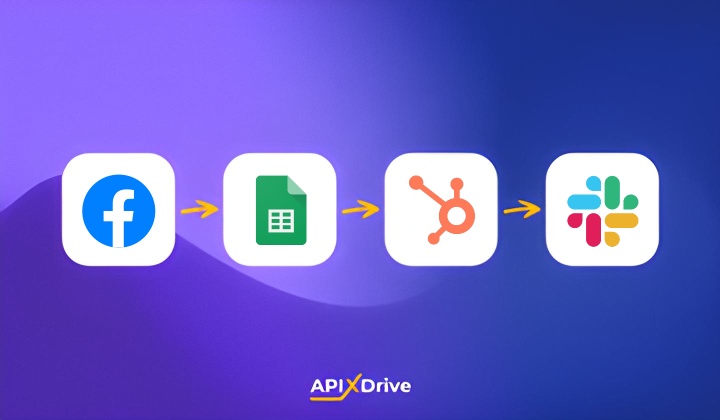
For our use case, we selected an industry-standard tool stack. Our goal is to create a chain where data is not simply transferred but replicated for analytics.
- Facebook Lead Ads: Source of new leads.
- Google Sheets: Database for backup and quick reporting.
- HubSpot (CRM): Professional environment for sales managers.
- Slack: Team notifications about new requests.
Step 1: Add New Row in Google Sheets
The first step in our integration is automatically transferring data to Google Sheets. Many people skip this step, thinking that a CRM is sufficient. However, for marketers, a spreadsheet is a versatile tool. Thanks to ApiX-Drive, as soon as a user clicks the “Send” button on Facebook, the system creates a new row in your document within 120 seconds. This eliminates the risk of data loss due to technical issues in the CRM or accidental deletion of a contact.
Step 2: Create Deal in HubSpot
HubSpot is one of the most popular CRMs in the world due to its flexibility. Our automation not only transfers contacts but also creates a fully-fledged deal entity at the appropriate stage of the funnel.
- Result: The managers don't need to manually enter the name and phone number. They open the card with all the necessary information already filled in.
- Numbers: Manually entering one lead into the CRM takes an average of 3-4 minutes. With a monthly volume of 100 leads, that's over 5 hours of pure work saved thanks to automation.
Step 3: Notifications in Slack Channel
CRM is the foundation, but Slack is the team's lifeblood. By setting up integration with your corporate messenger, you receive automatic notifications in a separate channel (e.g., #new-leads). This ensures a prompt response to new requests, increasing the likelihood of a successful deal outcome.

Real Performance Indicators: Numbers Don't Lie
Let's compare two approaches to processing 250 leads per month (the average for a small business in the services niche).
Conclusions
Implementing the described case doesn't require the involvement of programmers or writing complex code. ApiX-Drive allows you to set up the integration in 15-20 minutes through an intuitive interface.
Lead processing automation isn't a luxury for large corporations but a necessity for any business. While your competitors are copying data from spreadsheets and advertising accounts, you're closing deals.