
Firecrawl Explained: Turning the Web into Usable Data with AI

For many years, developers used traditional tools to extract data from websites, making the process complex and time-consuming. Advances in artificial intelligence have brought intelligent web scraping technologies to the market, significantly accelerating and simplifying such operations. In this article, we'll discuss a leading solution for AI-powered website scraping and crawling — Firecrawl. You'll learn how this service works, its advantages and application scenarios, and how these technologies will evolve in the near future.
What Is Firecrawl and How It Works
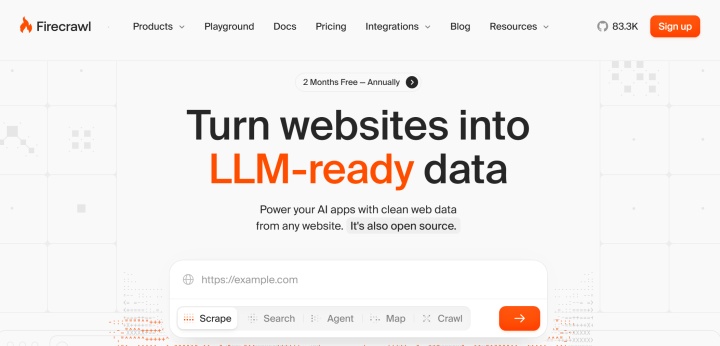
Firecrawl is an innovative API service for website scanning and scraping. Its AI models analyze content from websites, documents, and knowledge bases, converting it into clean, structured data in formats like HTML, Markdown, JSON, images, metadata, and screenshots.
The service uses specially trained artificial intelligence models to understand web page content like a human. It doesn't simply read and save HTML code; it understands the content, structure, and context of websites, carefully collecting, sorting, and organizing this data.
The data collected and processed by Firecrawl is used by developers to train and fine-tune large language models (LLMs). The API service crawls websites and scrapes their content, then delivers structured or unstructured data in LLM-ready format.
Firecrawl was launched by SideGuide Technologies in 2022. Its founders and leaders are Caleb Peffer (CEO), Eric Ciarla (CMO), and Nicolas Camara (CTO). Headquartered in San Francisco, USA.
In August 2025, the startup received $14.5 million in venture funding during its Series A investment round. At the time, more than 350,000 developers had registered on the platform. Its clients include well-known companies such as OpenAI, Shopify, Replit, and Alibaba.
Source: firecrawl.dev
Firecrawl pricing is presented in a range of plans:
- Free (500 credits, scrape 500 web pages, 2 concurrent requests, speed limits (10 scrapes per minute, 1 crawl per minute)).
- Hobby (3000 credits, scrape 3000 web pages, 5 concurrent requests, basic support, $9 per 1k extra credits) — $19 per month.
- Standard (100,000 credits, 100,000 web pages scraped, 50 concurrent requests, standard support, $57 for 30k extra credits) — $99 per month.
- Growth (500,000 credits, 500,000 web pages scraped, 100 concurrent requests, priority support, $217 for 150k extra credits) — $399 per month.
The pricing listed is based on monthly billing. Plans and features are subject to change; please visit the official website for the most current information.
Rethinking Web Scraping for the AI Era
The launch of Firecrawl has made AI-powered web scraping tools significantly more convenient and accessible. The startup has become a true game changer for the industry, radically altering the paradigm of modern web scraping with its AI-centric approach.
Firecrawl is based on a fundamentally different approach to web scraping, with AI models and semantic content analysis playing a key role. Unlike traditional solutions focused on mechanical HTML extraction, the platform was designed from the ground up as a data management tool for LLM and AI applications. Therefore, Firecrawl's architecture and operating logic differ significantly from traditional web scrapers in a number of ways.
Delivering Clean Data in LLM-Ready Format by Default
Previous-generation services simply read HTML code from website pages and deliver it to the user without prior analysis or filtering. As a result, the data they deliver is mixed with elements that are useless for LLM (ads, headers, footers, navigation elements, etc.).
Firecrawl algorithms intelligently analyze pages and filter their content, adding it to the database as unstructured or structured web data. The data they collect is in an LLM-ready format by default and can be used to train or tune AI applications without additional preparation or cleaning.
Zero Selector Paradigm
One key feature of Firecrawl is its ability to extract data without using CSS selectors. Users simply describe the information they need in plain English and submit a request to the system.
Next, AI models semantically analyze the structure and content of the relevant website, collect the information specified in the request, clean it of unnecessary elements, and return it in JSON text format or another form of your choice: metadata, images, links, etc.
Unified API
Firecrawl's functionality can be accessed through a simple, easy-to-configure API. It has several key endpoints for the service's core tools: scrape (scraping individual web pages), crawl (scraping entire websites), extract (extracting structured data), and more.
Note: Through the ApiX-Drive platform, you can optimize web scraping processes by implementing automated workflows with your existing business environment. Deploying Firecrawl integrations enables that extracted data is transferred to your target systems automatically and efficiently.

- Automate the work of an online store or landing
- Empower through integration
- Don't spend money on programmers and integrators
- Save time by automating routine tasks
Solving Additional Problems During Web Scraping
Firecrawl performs a number of additional tasks during its operation, improving the speed and quality of web scraping. For example, it automatically renders JavaScript (if the site uses this technology), using a headless browser to fully render the page before analyzing it. Furthermore, the service's AI algorithms rotate proxy servers to access websites that are inaccessible by default.
Key Features and Benefits
Firecrawl's features go beyond basic web scraping, covering the entire web data lifecycle, from collection and scanning to cleaning, structuring, and feeding into AI systems. The platform integrates several key tools. Each solves a specific class of problems and can be used both independently and as part of complex AI pipelines.
Firecrawl's main features:
- Scrape. Extracts data from a specific URL, delivering it in a user-defined format (HTML, Markdown, structured data, screenshots). It processes static and dynamic content and handles additional tasks, such as proxying, caching, speed limits, and more.
- Crawl. Collects data from an entire website by recursively scanning and analyzing the content of all its URLs. Ideal for transforming large volumes of information into LLM-ready formats.
- Agent. An autonomous tool for comprehensive web research and data gathering. It operates based on natural language prompts and does not require predefined URLs. The agent automatically searches the web, navigates complex site structures, and handles multi-step interactions to find and extract structured data efficiently.
- Search. This API endpoint allows finding required URLs online and extracting their content in a single operation. Here you can select the location and other search parameters, set the required data formats, adjust the number of results, and set timeouts.
- Map. Scans a website and finds all associated URLs, visualizing its structure as a detailed map. Allows you to quickly get a list of all links on a website or scrape only specific web pages.
- MCP Server. Firecrawl MCP (Model Context Protocol) allows for integration with external systems via API. Available on GitHub, this open-source server provides remote access to all platform capabilities — from search and web scraping to batch scraping and deep research.
Firecrawl's high demand among LLM and AI app developers is due to the significant advantages of its solutions. Its most significant advantages include:
- Process automation. Traditional scrapers require complex manual configuration and custom code for different site structures and data formats. With Firecrawl, you only need to enable the API integration and send a request with the URL and brief instructions to the AI agent.
- Processing speed. Manual scraping often takes hours or even days, especially when processing websites with large amounts of JavaScript code. Firecrawl web scraping scans and extracts structured data from web pages in minutes thanks to its API and AI algorithms.
- Advanced AI options. The service's AI algorithms extract only the content the user needs from websites and convert it into the user's specified format.
- LLM integration. Firecrawl supports integration with popular LLM frameworks, including LangChain, LlamaIndex, and CrewAI. This allows you to quickly transfer collected data to LLM for various tasks (analysis, content generation, etc.).
- Ease of use. Traditional scraping requires developers to have specialized knowledge (CSS selectors, XPath expressions, etc.). Firecrawl allows you to describe the required data in natural language, significantly simplifying and speeding up its extraction.
Real-World Use Cases
Firecrawl's AI data extraction tools have a wide range of application scenarios in the modern world. Thanks to its AI-centric approach to collecting and processing web data, the platform is used in many industries, from intelligent systems development to analytics and commercial solutions.
AI Applications
Automated scanning and extraction of structured web content enable quick and efficient training of LLMs for AI assistants and other types of AI applications. Developers widely use Firecrawl to create chatbots, knowledge bases, RAG systems with up-to-date documentation, and alternative AI-enabled software. Collected and processed data is automatically uploaded to LLM via framework integrations.
SEO/GEO Platforms and Web Analytics Platforms
Source: firecrawl.dev
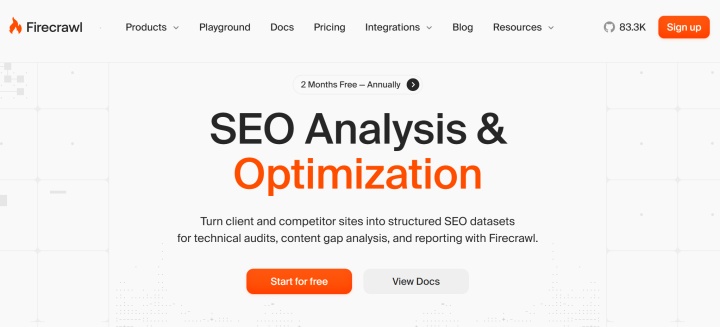
Firecrawl's AI scanning and data collection capabilities make it an effective solution for creating various systems for analyzing, optimizing, and promoting websites across both SEO and GEO. The data it provides can be used for technical SEO (webpage performance and crawlability), content readability assessment by AI algorithms, website structure and semantic analysis, SERP tracking, and other purposes.
In-Depth Research
The AI web crawler provides a continuous supply of large volumes of data for developing and training specialized AI agents for in-depth research and complex reasoning. Analysts, scientists, researchers, and other specialists use Firecrawl's deep research mode to automatically collect and process the data they need from hundreds of web sources.
Marketing, Sales, and eCommerce
Automated web content scraping and crawling help businesses generate and filter leads, quickly funneling them into sales funnels. The collected data can be used for accelerated campaign preparation, competitor analysis, and other marketing purposes.
Firecrawl also enables faster and more productive generation of new web content using AI. It will be equally useful for online stores and other eCommerce platforms, enabling automated large-scale monitoring of products, prices, reviews, and additional data.
Finance and Investments
The platform's tools enable more accurate and effective analysis of companies' business performance, stock prices, and additional financial metrics. Automatic data transfer to specially trained LLMs will provide specialists with personalized AI insights, including predictive analytics and other relevant information on finance and investment.
The Future of AI-Driven Web Crawling
The emergence of Firecrawl AI and other similar services opens up vast prospects for the development of targeted and mass data extraction from the internet. At the same time, AI-based anti-crawling solutions (e.g., Cloudflare) are rapidly improving.
One of the key trends in the upcoming years in this field is the confrontation between scrapers and anti-scraping tools. The widespread use of AI will contribute to the continuous sophistication of these technologies. Ultimately, this will create significant challenges for the industry, forcing developers to constantly implement new methods to bypass blocks and restrictions.
Finally, another significant trend is the active integration of AI-powered web scraping services with third-party applications and systems. Such tools are already widely used in eCommerce, retail, marketing, sales, finance, and media. Their widespread use may soon expand to other industries, from medicine and science to the automotive industry and tourism.
Compliance Note: While automation tools help you extract data efficiently, users must ensure their activities align with website policies (Terms of Service, robots.txt) and data protection laws like GDPR. The responsibility for the lawful collection and use of data lies entirely with the user.