Data-Driven Communications: How to Turn Calls into Data and Scale Business with CRM

Imagine you spent $2,000 on advertising in a month. Some went to Google, some to Facebook, and a little more to banners. Sales representatives answered calls, recorded something in the CRM, and forgot something. The month is over. There are sales, but you can’t say for sure which advertising brought them.
Sounds familiar? This isn't a small business problem — it's a systemic gap that even companies with serious marketing budgets have. Calls remain almost the only channel where data is collected haphazardly or not at all.
Below is how to change this without too much technical headache.
Why a Call Is Not Just a Conversation but Data
We've learned to track a user's online behavior quite well: where they came from, what they looked at, and where they left an email. But as soon as a person dials a number, this thread breaks. The representative hangs up, and all that's left is a subjective mark in the CRM or nothing at all.
Meanwhile, this conversation has everything: the client's real objections, their pain points, the question of price, and mentions of competitors. This is much more valuable feedback than any marketing research. But no one structures it.
A data-driven approach to communications is when each call is transformed into a set of data: where the client came from, how long the conversation lasted, what they asked about, and how the interaction ended. And all this is done automatically, without the account manager having to enter anything manually.
Call Tracking: Finally Understanding Which Advertising Really Works
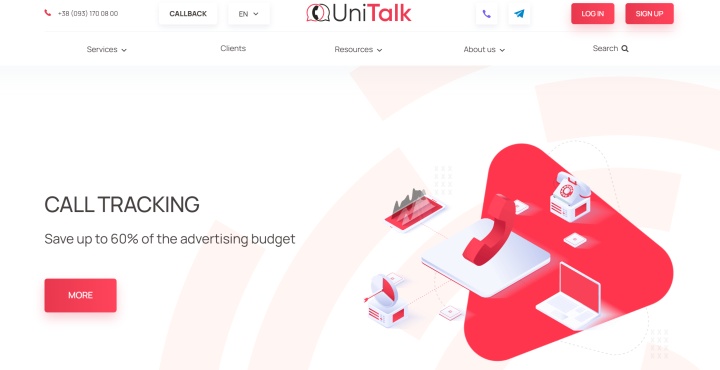
The first thing to start with is tracking call sources. Call tracking changes the phone number on your website depending on where the visitor came from. A customer who found you through Google Ads sees one number. Someone who came from Facebook sees another. The system records which number the call came from and matches it to the advertising source.
In practice, this reveals quite unexpected things. For example, one campaign generates many calls, but most of them are questions about opening hours or address. The second campaign generates a third of the calls, but every second one ends in a deal. Without call tracking, you invest in the first one because "there are more calls." With call tracking, you transfer the budget to the second one and grow sales without increasing costs.
This is not a theory. This is a solution that modern omnichannel platforms are implementing — in particular UniTalk OMNI, where call tracking, telephony, and analytics are all in one interface. For businesses where calls are a key lead generation channel, this is a significant advantage.
Source: unitalk.cloud
Conversation Analytics: Hearing What Customers Don’t Write About
Listening to call recordings manually is a real pain. If you have 50+ calls a day, spot-checking gives a false sense of control: you listen to 5 recordings and think you understand the picture. But in reality, you don’t.
Speech analytics solves this problem differently: the system automatically transcribes the conversation and looks for specific triggers in it. These could be competitor names, the words "expensive" or "I'll think about it," requests for installments, complaints about delivery — anything that matters to you.
One real-world case study: a company selling furniture online noticed a drop in conversions. Analysis of calls using the keyword "installment payments" showed that customers ask about this option in almost every third call, but agents don't offer it themselves; they wait until they're asked. After this word appeared in the script as a mandatory item, conversions began to recover.
Without conversation analytics, this insight could have gone unnoticed for months.
Automatic Data Transfer to the CRM: Let Sales Reps Sell, Not Enter Data
Even if you have call tracking and call recordings, all of this is meaningless if the data doesn't get into the CRM automatically. A sales rep who has to manually create a card and fill in the fields after each call will eventually start to "forget". Especially during a busy workday.

- Automate the work of an online store or landing
- Empower through integration
- Don't spend money on programmers and integrators
- Save time by automating routine tasks
The chain should look like this:
Call → automatic source capture → conversation recording → transcription → card in the CRM with all information.
The agent hangs up the phone and immediately sees a ready-made lead in the CRM with a linked conversation record, UTM tags, and call time. All they have to do is continue working with the client — instead of spending 3 minutes on routine after each conversation.
Such integration is now set up without needing developers — through ready-made connectors between telephony platforms and popular CRMs. It’s just important to make sure that the system you choose supports your stack.
Omnichannel: When the Customer Is No Longer “New” Every Time
A separate problem is when a client called a month ago, then sent a chat message, and then called again. And each time they get to the sales representatives without any context of previous calls. The client again explains who they are and what they want.
This is not just inconvenient — it is a signal of the lack of a system. Omnichannel platforms solve this problem: all requests (calls, chats, messengers) are collected into a single customer card. The agent who picks up the phone immediately sees the entire history of the interaction and can structure the conversation differently.
For example: "I see that you were already interested in our product in March. Then the price stopped you — we have a promotion now that may be relevant." This is a completely different level of service than the standard "How can I help?"
From Data to Solutions: What’s Really Changing in Business
All of the above is not for the sake of data itself. Data is interesting when it allows you to make decisions that you previously could not make or made at random.
A few practical examples:
Team training. Call analysis shows which conversation scenarios are more likely to result in a sale. These scenarios become the basis for training new sales reps — instead of abstract advice like "speak confidently and listen to the customer."
Product development. If you regularly receive calls requesting a service that you don't have, that's a signal. Not a hypothesis, not a focus group, but real demand from your audience.
Marketing optimization. You don't just see "this campaign generated 100 calls," you see "this campaign generated 100 calls, 30 of which converted into deals, and the average order value (AOV) was X." That's a whole other level of understanding ROI.
Bottom Line
A phone call has long ceased to be just a means of communication. For a business where live communication with a client is part of sales, each conversation is also a source of data about the market, competitors, and the real needs of the audience.
The problem isn't that this data isn't available — it's in every recorded conversation. The problem is that without the right infrastructure, it's dead weight.
Call tracking, speech analytics, and automatic CRM integration are not expensive enterprise solutions. Today, there are tools available to businesses of all sizes. Companies that start using them gain an advantage not because of a larger budget, but because of better information for decision-making.
Read also on our blog:
- Common Survey Formats You Can Create Using Web Forms
- How to Automate Gmail Attachment Processing
- Firecrawl Explained: Turning the Web into Usable Data with AI
- Apollo.io Explained: How This Platform Supercharges Sales and Lead Generation
- Creating an End-to-End Ecosystem for Processing Leads from Facebook Lead Ads