
Best Keyword Research Tools in 2026

Search engine strategies have evolved dramatically and grown far more complex in recent years. This shift is largely driven by advances in search algorithms and AI-powered applications. At the same time, many specialized SEO/GEO solutions have appeared on the market. In this article, we cover one core solution: keyword research tools. By reviewing the top keyword research tools for 2026, you can choose the best fit to optimize your website for both search engines and generative AI.
What Are Keyword Research Tools
Keyword research tools are platforms that help marketers and SEO professionals analyze user search queries. By tracking these searches, they identify popular topics, questions, and high-value target phrases.
Previously, these platforms focused on traditional search engine optimization (SEO) for Google and Bing. Today, they also power Generative Engine Optimization (GEO), helping brands optimize content for AI search features like Google AI Overviews, ChatGPT, and Perplexity.

The capabilities of such solutions are not limited to identifying and counting the number of search queries on a given topic. The range of tasks they perform includes:
- Search query analysis. Keyword research tools can filter and organize search queries into relevant keyword groups. These tools can be used to identify long-tail queries, queries with questions, voice queries, and more.
- Identifying topic clusters. Research services identify topic clusters related to the primary search query. This is crucial for analyzing the visibility of a particular topic, brand, or resource by AI systems, which assess authority not only by direct keyword matches but also by the size of the topic cluster.
- Collecting relevant data from AI summaries. These tools analyze AI-generated answers compiled from multiple web sources. They surface user questions, comparison queries, and problem-solving phrases, making it easier to craft content that AI search engines frequently cite.
- Entity-based search support. AI models rely less on exact keywords and more on related entities like products, people, brands, and concepts. Modern research tools map out these connections, helping you structure content around the knowledge graphs used by search engines.
Ahrefs
Source: ahrefs.com
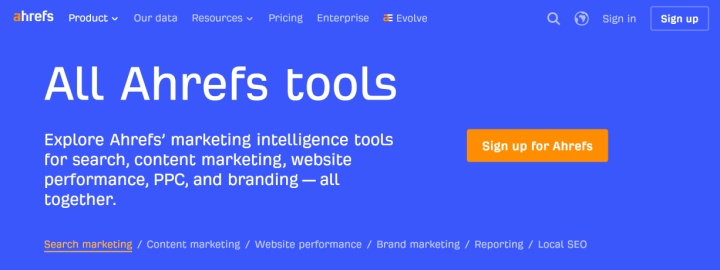
No list of top SEO software in 2026 is complete without Ahrefs. Trusted by many Fortune 500 companies, Ahrefs provides robust competitive analysis and search data. Its dedicated module, Keywords Explorer, helps marketers analyze essential search metrics with high precision.
Key features:
- Ahrefs has a massive database containing billions of search queries from various engines and locations (200+ countries). It offers search options for countries, related queries and search suggestions, long-tail keywords, and more.
- The Keyword Difficulty (KD) calculation helps assess the difficulty of ranking for a specific query. It can also help identify less competitive queries for which it would be easier and faster to rank a website or brand.
- The service displays monthly search volume and historical trends for each tracked keyword: average monthly search volume, seasonal fluctuations, global search volume or search volume by country, etc.
- Ahrefs estimates traffic potential and the number of clicks from search results generated by a specific keyword. This helps you identify keywords that drive more traffic.
- The platform automatically generates semantically related queries, queries with a target phrase, search suggestions (autocomplete queries), and queries formulated as questions.
Ahrefs offers 5 core pricing tiers:
- Starter ($29/mo): Entry-level access to Site Explorer and Keywords Explorer for basic checks.
- Lite ($129/mo): Includes core research tools, up to 5 projects, 750 tracked keywords, and 6 months of historical data.
- Standard ($249/mo): Adds Content Explorer, up to 20 projects, 2,000 tracked keywords, and 2 years of historical data.
- Advanced ($449/mo): Built for in-house teams, supporting 50 projects, 5,000 tracked keywords, and Looker Studio integration.
- Enterprise ($1,499/mo): Custom limits, API access, SSO, and dedicated support.
Surfer SEO

Source: surferseo.com
Surfer SEO is a leading AI-driven research platform. It combines proprietary database metrics with real-time Google SERP data to simplify keyword selection and analysis.
Key features:
- The service automates keyword clustering, grouping them into thematic categories. This simplifies content plan development by providing ready-made keyword sets for articles and web pages.
- Surfer generates reports with monthly search volume metrics for specific keywords. Users can track how many times a particular query was searched per month and the overall search demand for that keyword.
- The Keyword Research module in Surfer helps you find target queries, estimate their monthly search volume, and automatically group search phrases into thematic clusters to create content plans.
- The platform's tools allow you to determine user search intent (informational, local, shopping, customer research) by analyzing top search results.
- Based on an analysis of Google's top search results, NLP (natural language processing) algorithms determine a list of required keywords, entities, and related terms. The service evaluates the quality of content optimization using its own Content Score (from 0 to 100), helping to adapt articles to Google's algorithms and AI summaries.
Surfer SEO features several flexible plans:
- Standard ($119/mo): Includes basic content optimization, article editor features, and keyword research tools.
- Pro ($219/mo): Offers expanded document limits, internal linking suggestions, and multi-user seats for growing teams.
- Peace of Mind ($359/mo): Provides advanced SERP analysis, high document volume, and dedicated onboarding.
- Enterprise: Custom document limits, white-label options, priority support, and API access.
AnswerThePublic
Source: answerthepublic.com
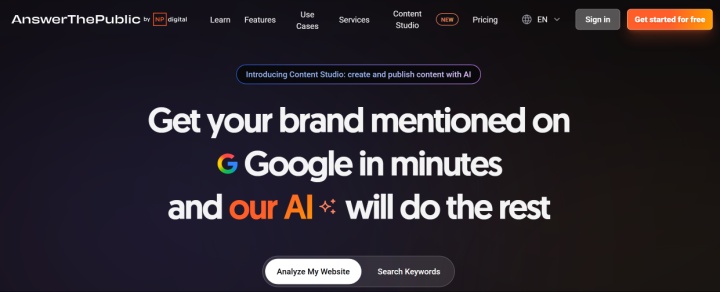
As conversational AI and chatbots evolve, traditional SEO tools can miss unique conversational search patterns. SEO specialists should consider adding AnswerThePublic to their keyword discovery toolkit. The platform focuses specifically on visual question mapping and long-tail query research. It serves as an essential tool for crafting content strategies that directly answer audience questions.
Key features:
- The service collects search suggestions. For convenience, it presents them in the form of semantic maps. This provides search suggestions based on queries entered by users rather than hypothetical keyword ideas.
- The platform categorizes collected queries, dividing them into groups: question words ("how," "what," "why"), comparisons ("or," "vs"), etc. This approach is best used when writing expert-level articles for GEO and creating content for FAQs.
- AnswerThePublic identifies problem-solution queries and low-frequency long-tail keywords that have the highest chance of being included in AI-generated answers.
- The service studies search trends in dozens of languages, linked to specific countries and regions. This is an important feature for users focused on local promotion.
- The platform tracks changes in search queries and sends reports to users when new questions on a given topic become top searches.
AnswerThePublic provides 3 main pricing tiers:
- Starter ($10/mo): 1 user, 100 searches per month, 1,000 monthly prompt suggestions.
- Growth ($49/mo): Up to 3 users, 200 searches per month, 2,000 monthly prompt suggestions.
- Business ($99/mo): Up to 10 users, 300 searches per month, 3,000 monthly prompt suggestions.
Serpstat
Source: serpstat.com
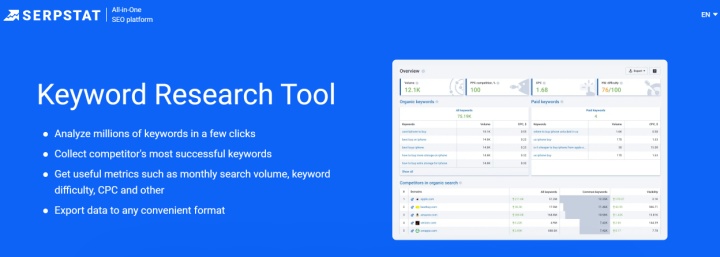
Next on our list of top keyword research software for 2026 is Serpstat, an all-in-one search analytics platform. It provides users with an impressive set of tools for keyword research, search demand analysis, and SEO/PPC strategy development.
Key features:
- The platform boasts a robust database of billions of search queries from over 200 countries. It enables research across global and local markets, various search engines, and regions.
- Serpstat generates a large number of related keywords and their variations, autocomplete suggestions, long-tail queries, article topic ideas, and question queries.
- The platform analyzes a range of metrics to assess the value and competitiveness of keywords: search volume, keyword difficulty (KD), cost-per-click (CPC), PPC competition, SERP data, etc.
- Using the competitive analysis feature, you can get detailed information about the keywords your competitors' websites rank for. It allows you to compare keyword profiles across different domains and identify gaps in keyword coverage.
- Automatic grouping of related keywords into clusters based on semantic similarity helps you effectively structure your website content and pages.
Serpstat offers 3 straightforward subscription tiers:
- Individual ($69/mo): Supports up to 5 projects, 100 daily searches, 10,000 position checks, and 30,000 audited web pages per month.
- Team ($129/mo): Unlocks unlimited projects, 500 daily searches, 50,000 position checks, 150,000 audited pages, and API access.
- Agency ($499/mo): Built for scale with 5,000 daily searches, 500,000 position checks, 1.5 million audited pages, white-label reports, and phone support.
Keyword Research With AI Bots
Generative chatbots represent a distinct category for topic research. While they cannot replace dedicated SEO software due to a lack of search volume metrics, they excel during the initial discovery phase, helping you map out broad topics and niche angles before digging into hard data.
Key tasks:
- Understanding search intent and buyer pain points. Assigning a prompt role to a chatbot (for example: "You are an IT director selecting a CRM system") helps surface realistic search queries your audience would actually use. This process also gives you direct visibility into common customer pain points and how users frame their search intent.
- Generating long-tail and related queries. If you need to expand your core keywords, find synonyms, or find less common, low-volume keywords, it's worth using AI. Chatbots are excellent for this task.
- Automatic categorization. Chatbots generate a list of hundreds of keywords in seconds, categorizing them by topic, intent (informational, transactional, commercial), sales funnel stage, and more.
- Generating ideas for GEO and AI Overviews. Chatbots formulate search questions based on requests using the popular "People Also Ask" and "Problem-Solution" formats, which can help identify query patterns relevant to AI search.
Conclusion
The tools covered in this guide give marketers and SEO professionals everything needed to streamline research, analyze competitors, and track performance. By incorporating these solutions into your workflow, you can boost organic traffic and prepare your content strategy for the era of AI search.
Note: Pricing, features, and plan details mentioned in this article are accurate at the time of writing. Software providers frequently update their subscription tiers and feature offerings, so please check the official websites for the most current pricing and availability.