Understanding the Concept of Product-Led Growth (PLG)

Traditional go-to-market frameworks reliant solely on outbound sales and aggressive marketing campaigns are yielding diminishing returns. To maintain efficient scaling, software companies are shifting toward the Product-Led Growth model. Adopting a cohesive PLG strategy turns the product itself into the primary engine for customer acquisition, retention, and long-term profitability. Understanding its core mechanics, foundational metrics, and operational trade-offs is essential for modern software executives.
What Is Product-Led Growth
Product-Led Growth (PLG) is a go-to-market strategy that positions the end-user product experience as the chief driver of customer acquisition, retention, and expansion. By prioritizing direct value delivery over sales friction, companies improve conversion rates and build defensible market positions.
This methodology emerged as a direct response to traditional sales-led and marketing-led go-to-market approaches.
In a sales-driven structure, human account reps gatekeep the experience through scheduled demos, manual prospecting, and contract negotiations. A marketing-led structure relies primarily on top-of-funnel brand campaigns and lead generation assets to capture interest.
A dedicated PLG strategy excels at driving scalable SaaS growth, particularly when software delivers rapid, self-serve utility. B2B category leaders in workflow automation, developer tools, and team collaboration platforms frequently leverage this architecture.
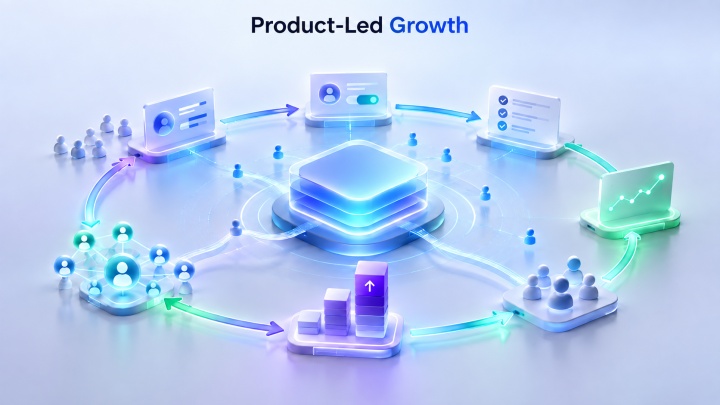
Transitioning to this framework aligns customer acquisition with organic product value. While legacy models often sacrifice margins to fuel aggressive top-line expansion, product-led architectures stabilize customer acquisition costs.
Global technology brands including Slack, Zoom, Dropbox, and Notion demonstrate the power of this methodology. Enterprise organizations routinely combine self-serve mechanics with Product-Led Sales strategies, analyzing telemetry data to identify high-value enterprise opportunities without eroding operating margins.
Automating workflows across these popular platforms is effortless with ApiX-Drive. The no-code connector enables seamless integrations for Dropbox, Slack, and Notion in just a few clicks.
Core Principles of a Product-Led Strategy
The PLG methodology relies on interconnected operational principles designed to minimize user friction and showcase software capabilities instantly.
Product-driven growth
Under a framework centered on product-driven growth, software functionality serves as the central acquisition channel. Rather than relying on sales pitches, organizations grant immediate access through self-serve tiers, allowing hands-on experience to validate utility and drive conversion.
Deliver value quickly
Lowering time to value (TTV) is critical for user activation. Providing instant trial access, intuitive workflows, and contextual guidance allows users to experience key features immediately, directly boosting conversion metrics.
Impeccable user experience

Accelerating time to value requires removing every unnecessary obstacle from the user journey. Self-service access, transparent pricing, and intuitive interface design empower end users to onboard independently without reaching out to technical support.
Free trial and freemium models
Demonstrating utility prior to monetization requires flexible entry models. Time-limited free trials grant complete feature access for a short evaluation window, encouraging rapid evaluation before converting to paid subscriptions.
The freemium business model provides an ongoing tier with entry-level functionality. Users explore core features indefinitely at zero cost, upgrading to commercial tiers when team demands or advanced feature requirements expand.
Usage-based pricing and expansion
Revenue expansion correlates directly with increased platform utilization. Organizations adopt scalable monetization structures such as per-seat tiers, usage-based metering, or storage thresholds that grow alongside customer operational volume.
Data-driven optimization
Engineering teams implementing product-led methodologies rely heavily on behavioral telemetry. Key indicators such as activation milestones, feature adoption, churn rates, and engagement telemetry guide iterative development decisions.
Continuous experiments
Sustained expansion requires persistent optimization. Product teams must continuously test every element of their user onboarding strategy, evaluating pricing tiers, in-app notification triggers, trial durations, and paywall thresholds.
Key Metrics That Drive PLG Success
To successfully implement a PLG strategy, revenue teams must regularly evaluate user behavior and platform engagement. Core set of SaaS metrics:
- Registration rate: The ratio of total website visitors who successfully create an account, reflecting top-of-funnel acquisition efficiency.
- Customer acquisition cost (CAC): Total sales and marketing expenditures divided by the number of new customers acquired within a specific timeframe.
- Free user volume: The active count of non-paying accounts participating in trial or basic tiers.
- Activation rate: The percentage of registered accounts that achieve a specific value milestone.
- Customer lifetime value (CLV): The total projected revenue generated by a single account throughout its operational tenure. This metric guides acquisition budgets and identifies high-value audience segments.
- Expansion revenue: Incremental recurring income generated from current clients via plan upgrades, add-ons, or seat expansion.
- Time to value (TTV): The duration required for a new user to realize tangible benefit after completing account creation.
- Product-qualified leads (PQL): Users who engage deeply with core features, reach activation thresholds, and signal buying intent through actual platform usage. Unlike marketing-qualified leads, PQL classification relies on verified behavioral telemetry rather than passive content downloads.
- Daily active users (DAU) and monthly active users (MAU): Quantitative measures tracking unique user engagement across daily and monthly windows. Calculating the DAU-to-MAU ratio determines platform stickiness.
- Free-to-paid conversion rate: The proportion of non-paying users who transition to paid subscription tiers.
- Retention rate: The percentage of customers who maintain active subscriptions over a designated measurement period.
- Churn rate: The percentage of accounts that cancel subscriptions over a given timeframe, establishing baseline net retention.
Benefits and Challenges of Product-Led Growth

Transitioning to a product-first go-to-market structure reshapes how organizations acquire, convert, and retain clients. Before committing to a full SaaS growth strategy, executive leadership must weigh the distinct advantages against the operational demands.
Advantages:
- Lower customer acquisition costs: Emphasizing self-service access reduces reliance on expensive outbound advertising campaigns and manual sales outreach. Automated onboarding, viral referral loops, and word-of-mouth adoption lower overall acquisition spend.
- Accelerated scaling: Automating user provisioning and account expansion enables organizations to onboard thousands of users simultaneously without proportional increases in headcount.
- Minimized time to value: Immediate feature access, clear interface navigation, and embedded guidance help users realize utility quickly, building early trust and accelerating purchase decisions.
- Enhanced customer retention: When adoption is driven by organic utility rather than aggressive sales tactics, users build genuine dependency on the platform, yielding higher long-term retention.
Challenges:
- Extreme dependency on user experience: Product-led frameworks require an exceptionally intuitive user interface. Complicated workflows or confusing setup steps instantly increase drop-off rates and stall revenue growth.
- Heavy reliance on analytics infrastructure: Driving expansion through software telemetry demands advanced tracking capabilities to evaluate activation rates, PQL thresholds, and feature utilization accurately.
- Delayed monetization: Offering free tiers defers revenue collection compared to upfront enterprise contracts. Organizations must support ongoing hosting and support costs while waiting for accounts to convert.
- Organizational alignment shifts: Adopting product-first growth requires structural alignment across product, engineering, sales, and marketing teams, replacing traditional lead handoffs with cross-functional customer success workflows.
Final Thoughts
The PLG framework represents one of several evolving approaches in how modern software companies operate and expand in 2026. Prioritizing end-user experience, rapid value realization, and transparent monetization creates a sustainable alternative to traditional sales-heavy go-to-market strategies for many SaaS businesses.
While managing free-tier infrastructure and aligning cross-functional teams presents real operational hurdles, organizations that effectively execute product-first expansion often build resilient, highly scalable software enterprises. That said, PLG requires the right product-market fit, strong analytics infrastructure, and organizational alignment. It's not suitable for every business model or customer segment.
Recommended reads: