How to Connect Elevenlabs as Data Search
Integration with ElevenLabs is implemented as a separate Search block, which can be placed between the Data Source and Data Destination. The Search block allows you to retrieve field values from the Data Source, generate queries to ElevenLabs based on them, and perform data searches and processing according to specified parameters. This block allows you to automatically perform operations with text and audio data, including text-to-speech, audio isolation, voice modification, and other available platform features. The resulting processing results are transferred to the Data Destination fields and can be used in other services and systems.
This function allows you to search and process data in ElevenLabs and transfer the resulting files.
Navigation:
Connecting Google Sheets as a Data Source:
1. What data can be get from Google Sheets?
2. How to connect your Google Sheets account to ApiX-Drive?
3. Select the table and sheet from which the rows will be exported.
4. Example of data that will be transferred from Google Sheets.
Connecting Elevenlabs as a Data Search:
1. What data can be get from Elevenlabs?
2. How to connect your Elevenlabs account to ApiX-Drive?
3. How to set up data search in Elevenlabs for a selected action?
4. Example of data that will be transferred from Elevenlabs.
Setting up Data Destination using Box as an example:
1. What will the Box integration do?
2. How to connect your Box account to ApiX-Drive?
3. How do I configure data transfer to Box in the selected action?
4. Example of data that will be sent to your Google Sheets.
5. Auto-update and update interval.
Setting Data SOURCE: Google Sheets
Let's take a look at how the Search feature works using the example of transcribing text from Google Sheets and transferring the generated audio files to Box.
First, you need to create a new connection.
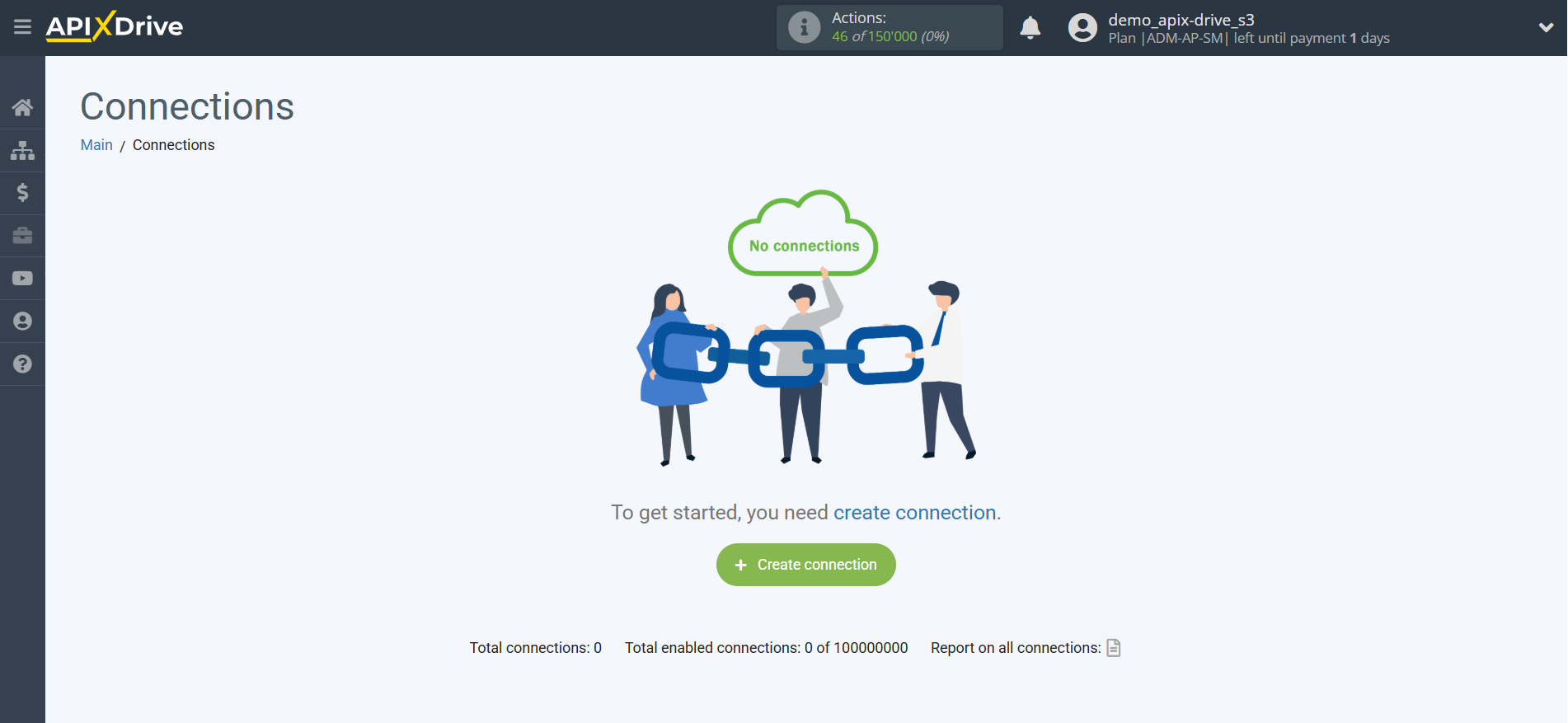
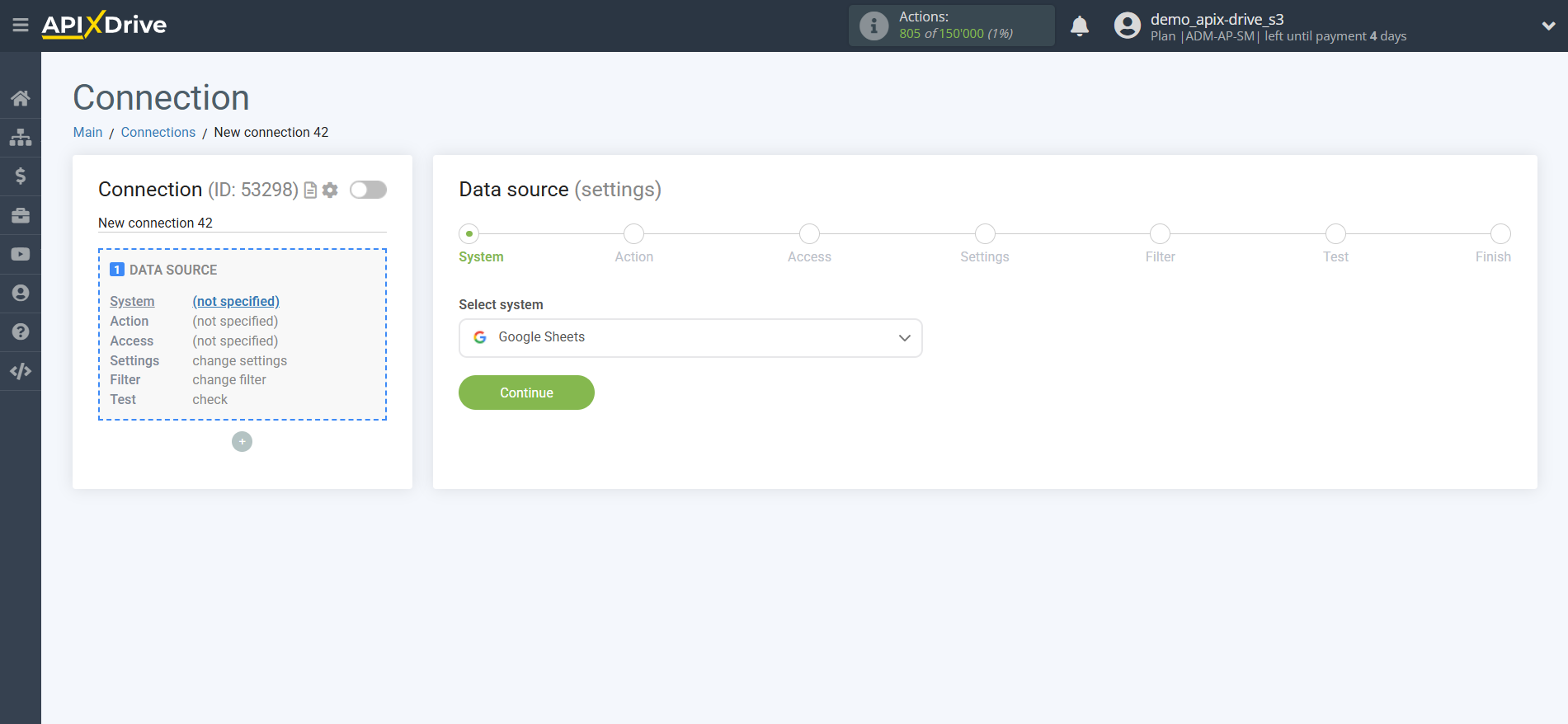
Select a system as the Data Source. In this case, you need to select Google Sheets.
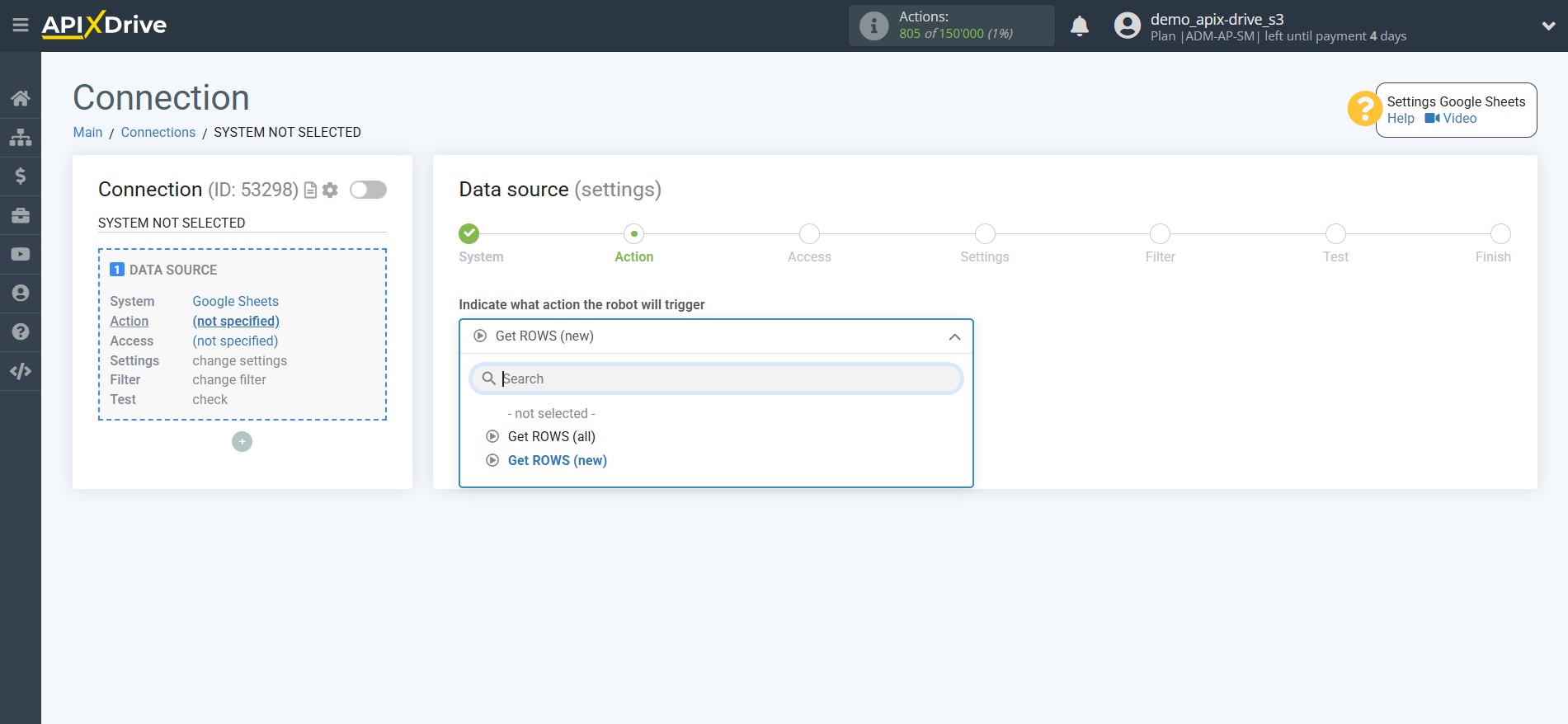
Next, you need to specify the action "Get ROWS (new)".
The next step is to select the Google Sheets account from which the data will be downloaded.
If there are no accounts connected to the system, click "Connect account".
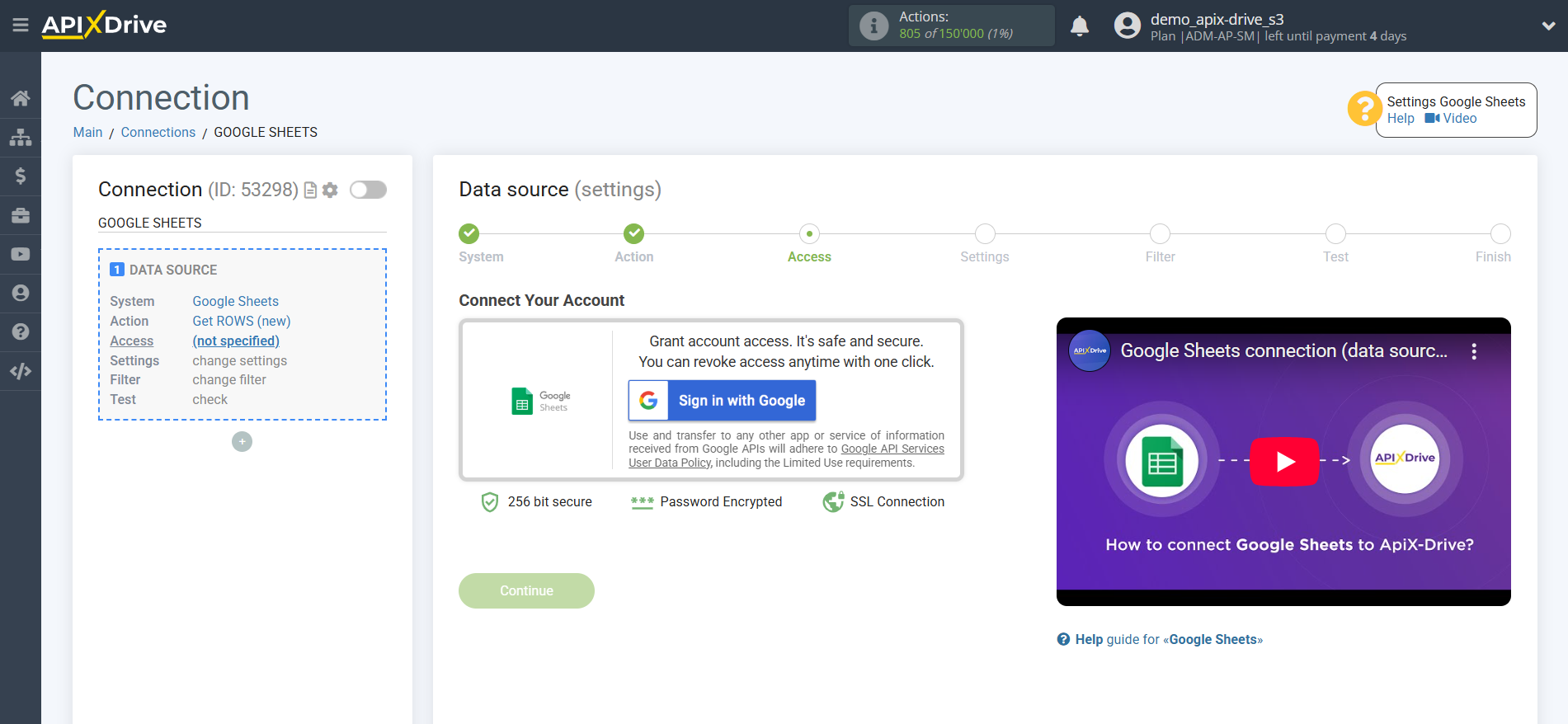
Select which account you want to connect to ApiX-Drive and grant all permissions to work with this account.
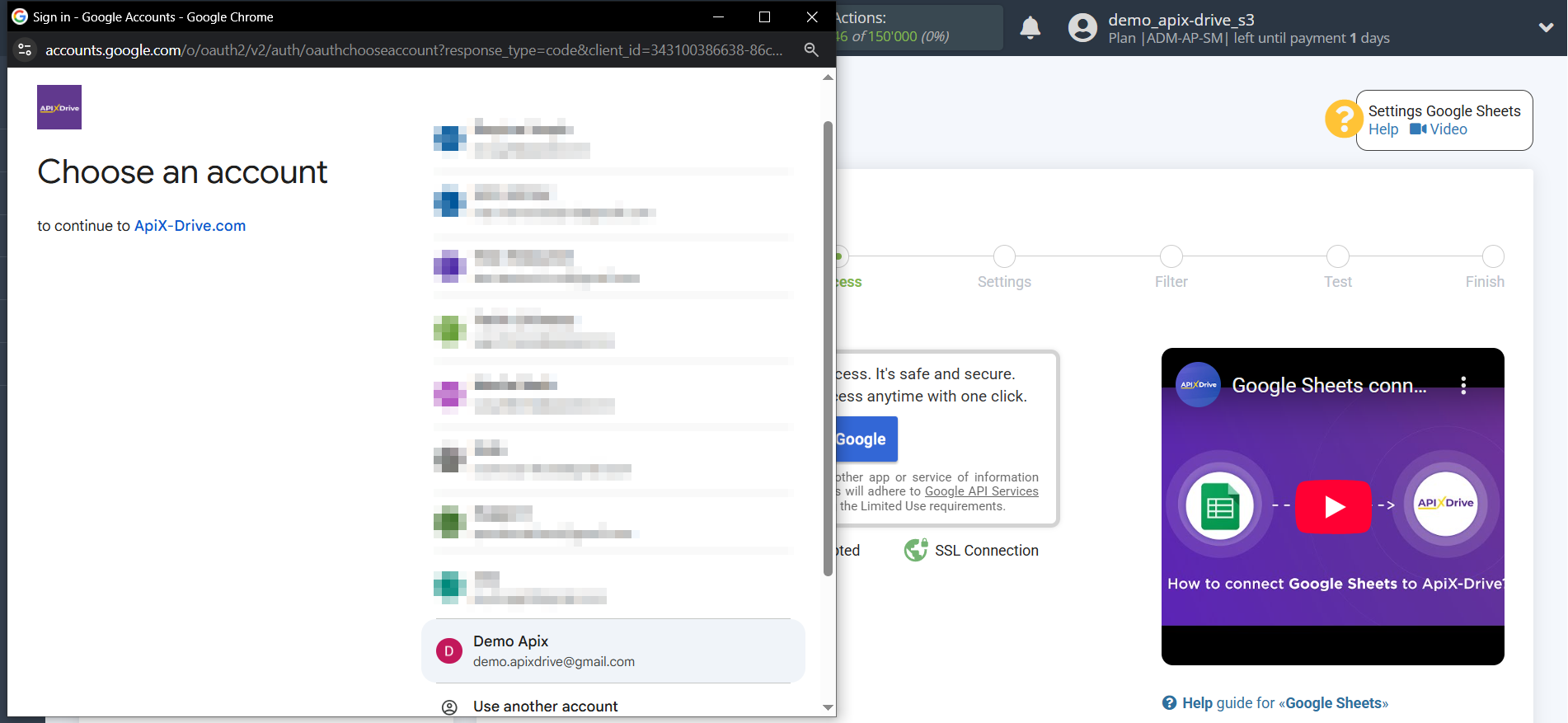
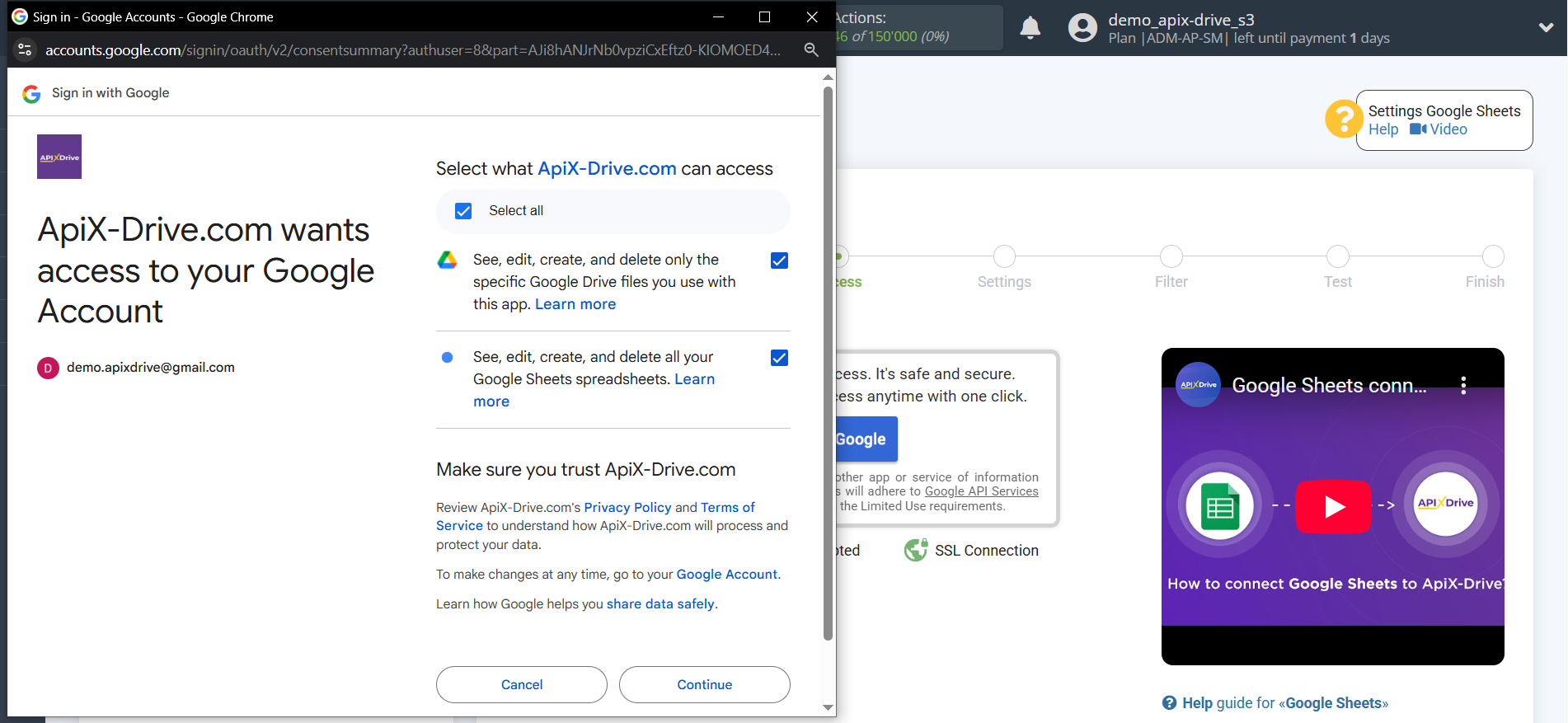
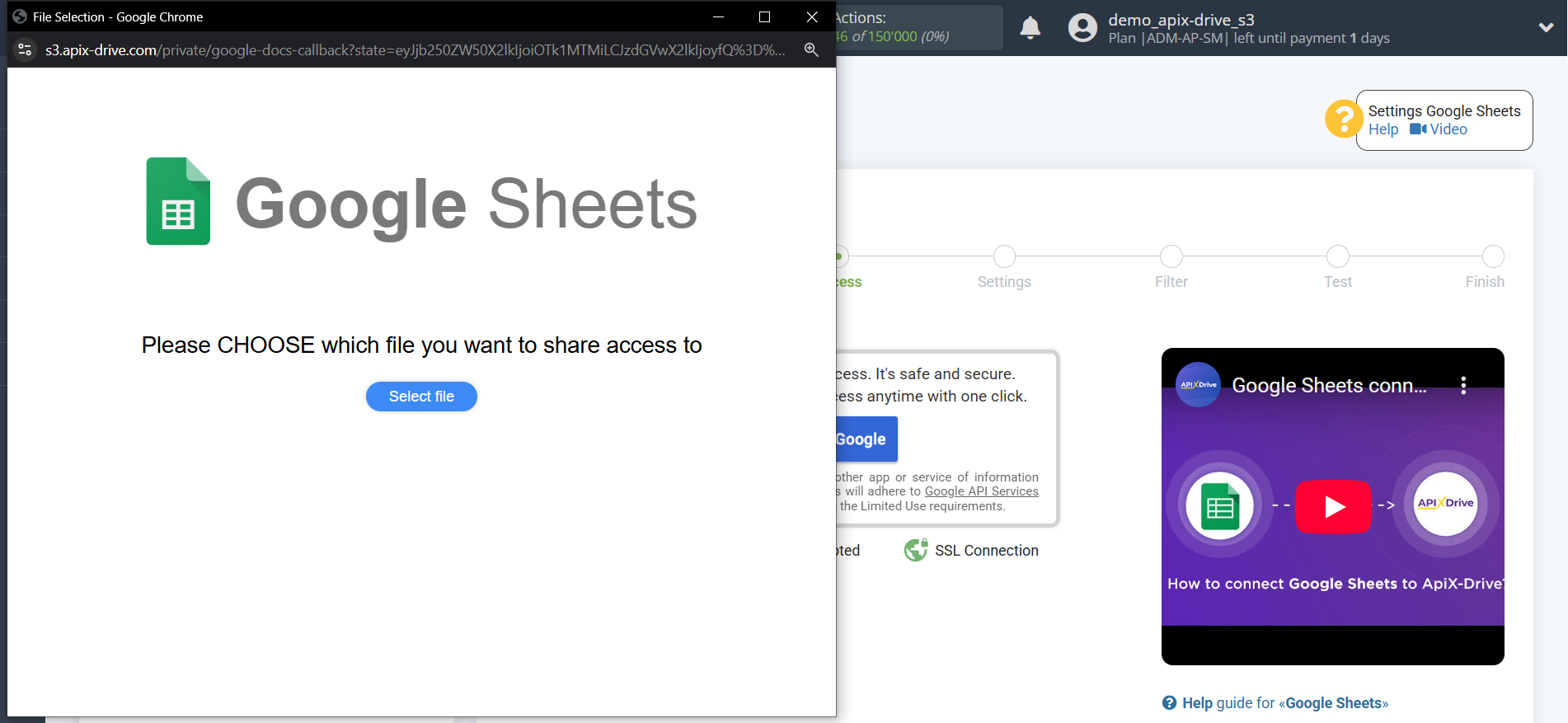
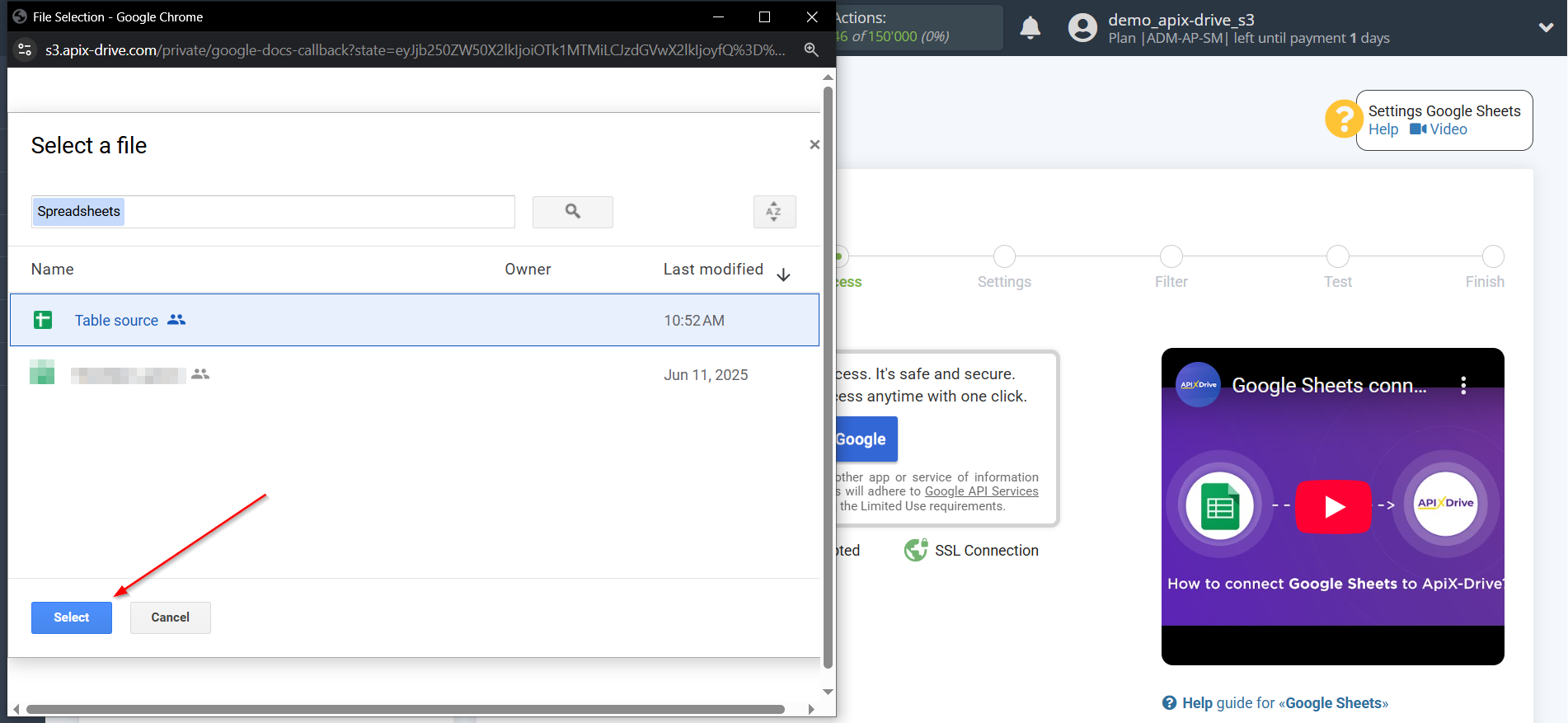
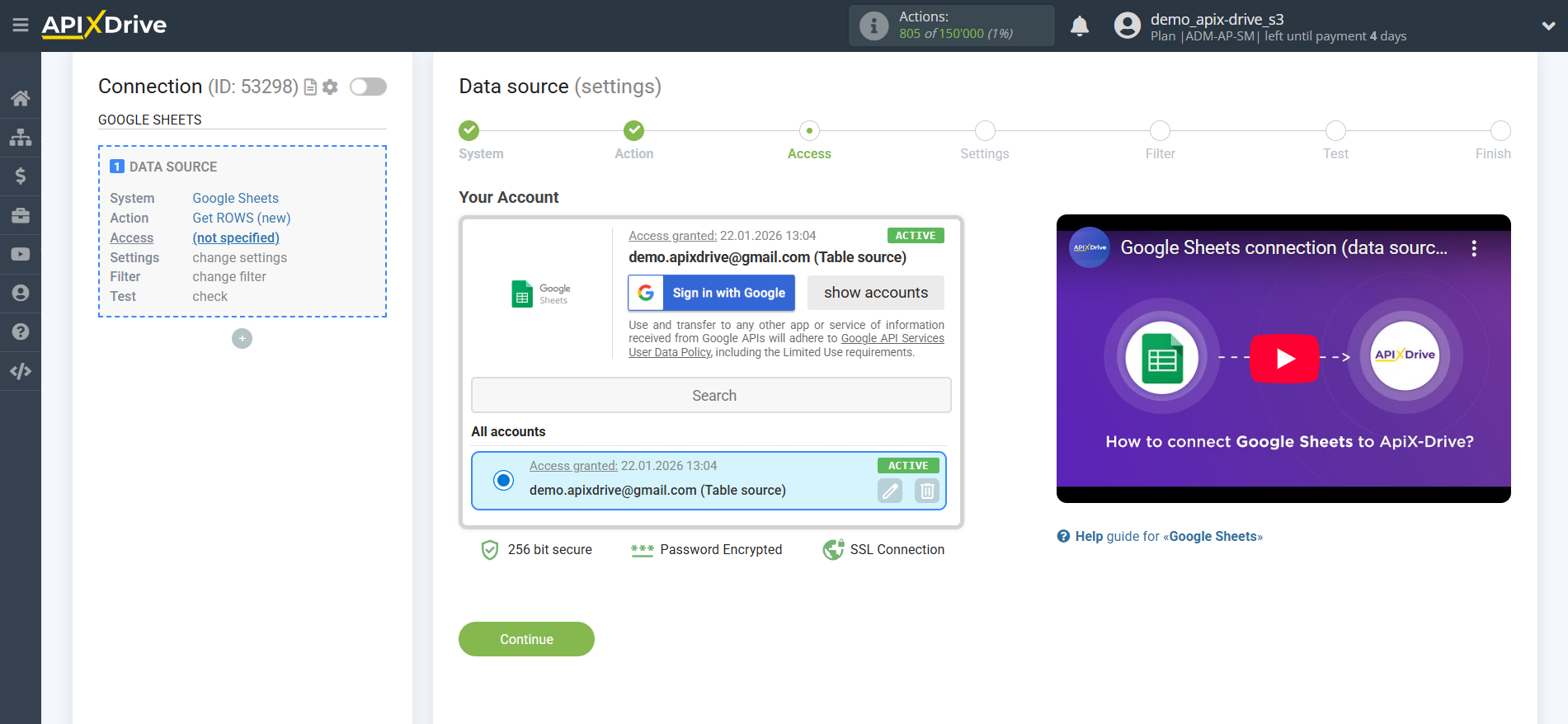
When the connected account appears in the "active accounts" list, select it for further work.
Attention! If your account is listed as "inactive accounts," please check your access to this account!
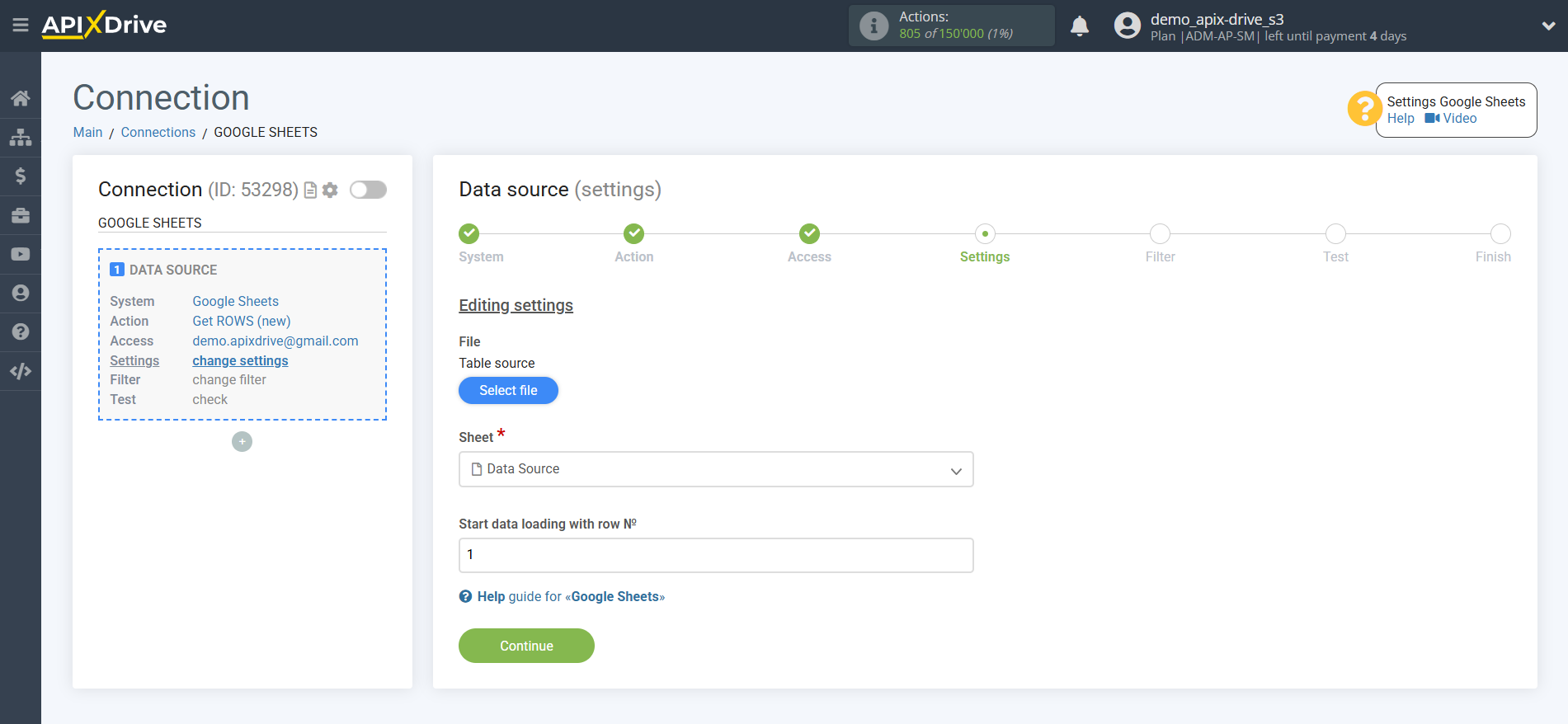
Select the Google Sheets table and sheet where the data you need is located.
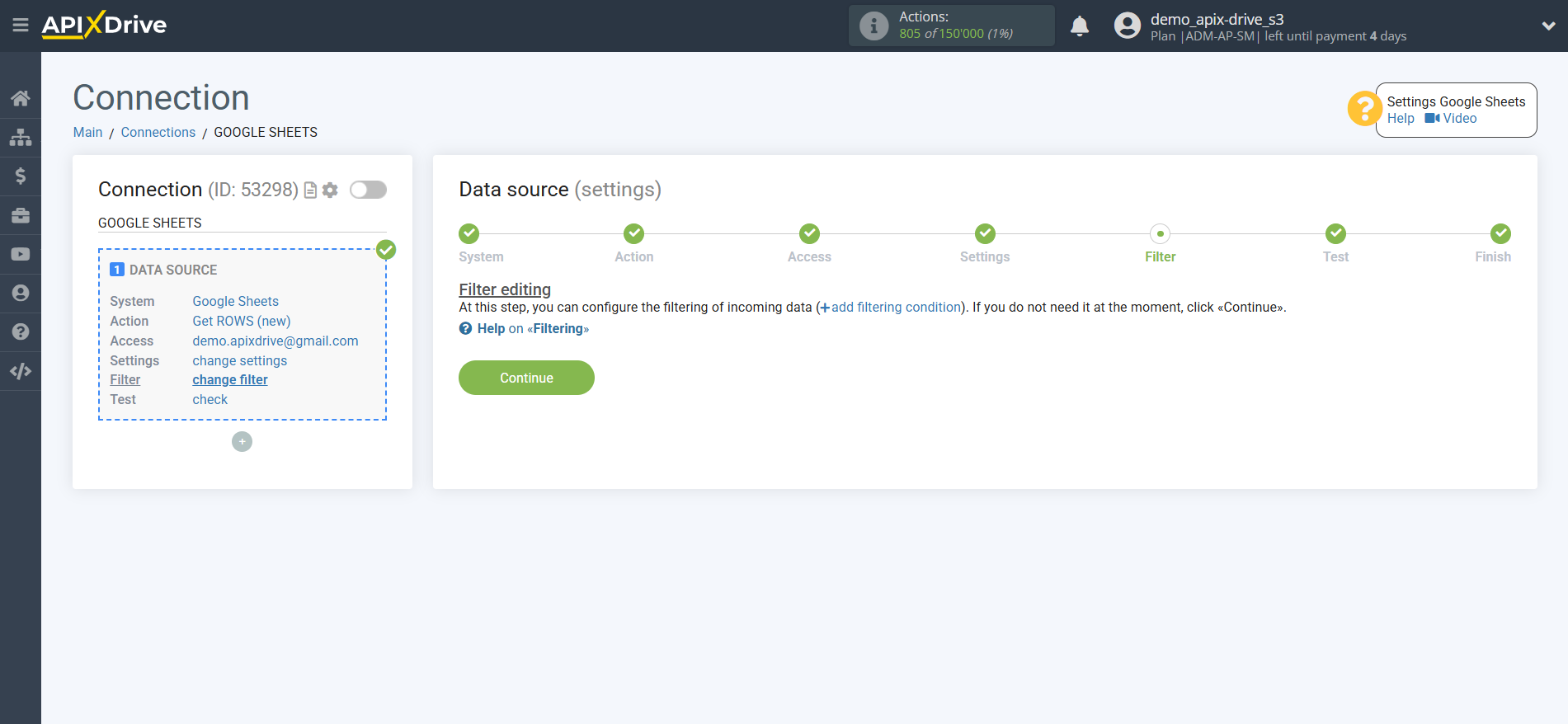
At this step, you can add a data filter to load not all rows, but only those necessary for further processing.
In this case, we don’t need this, so we click “Continue”.
To learn how to configure the Data Filter, follow this link: https://apix-drive.com/en/help/data-filter
You can now see sample data for one of the rows in your Google Sheets table.
If you want to update the test data, click "Load test data from Google Sheets".
If you want to change the settings, click "Edit" and you will go back one step.
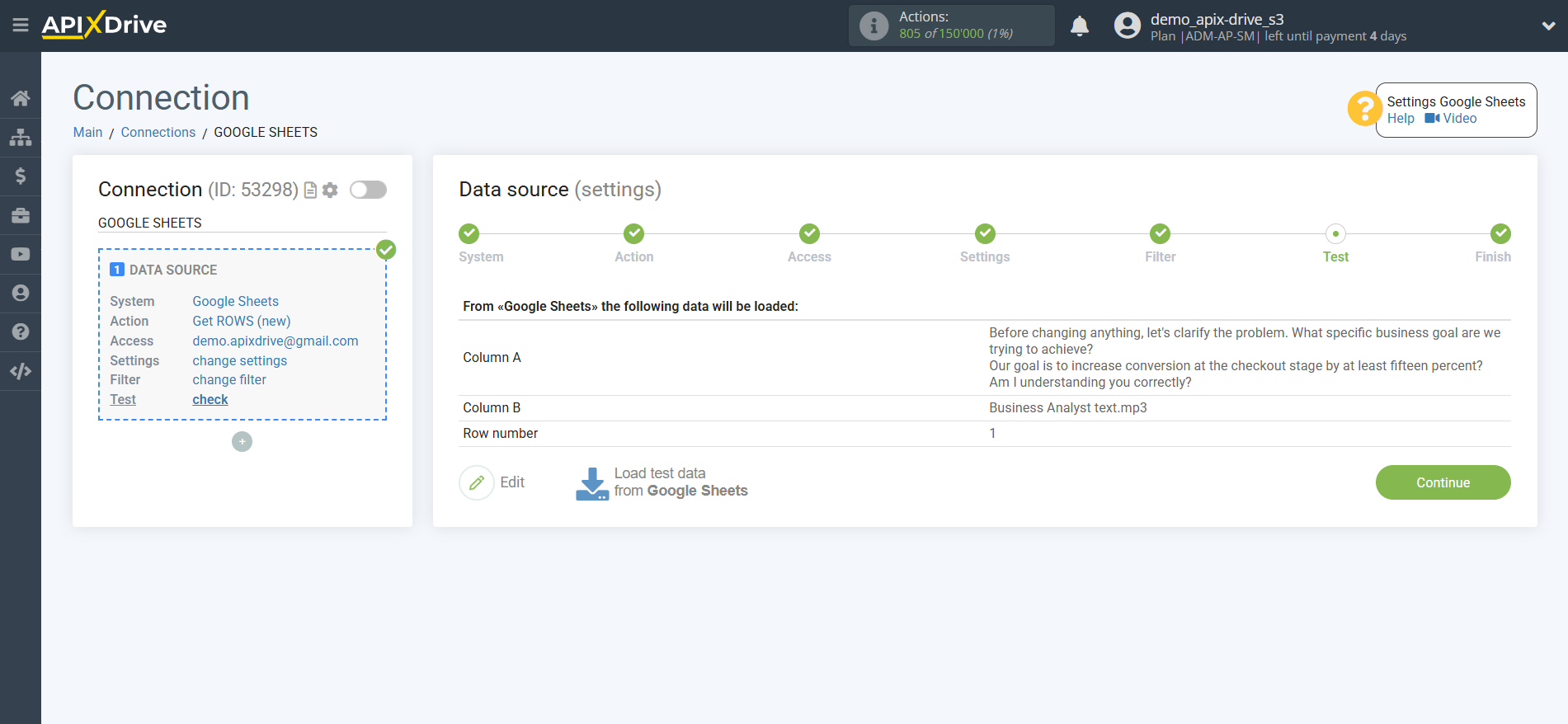
Now let's add the additional Data Search block. To do this, click the "+" button and select "Add Data Search" from the list.
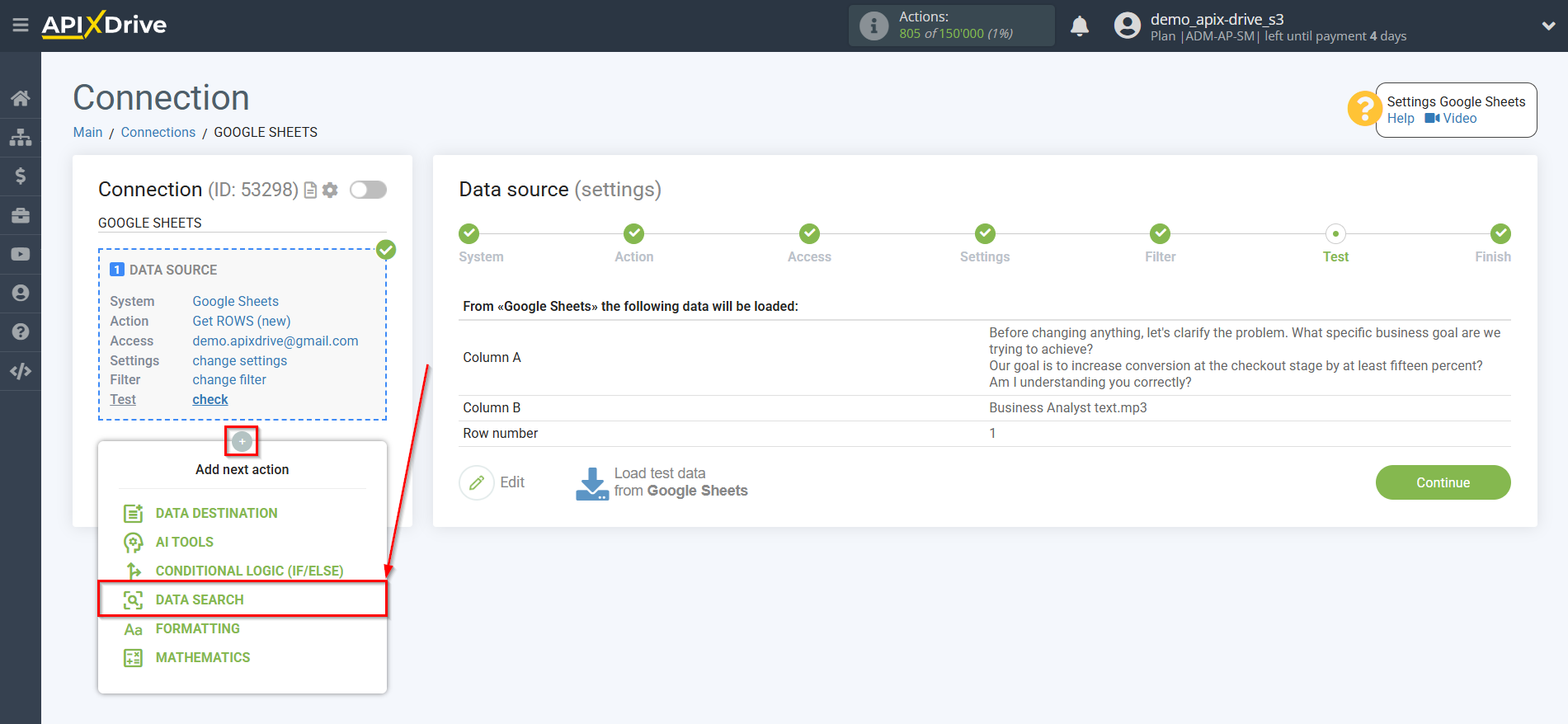
We select "ElevenLabs" as the system in which the search will be performed.
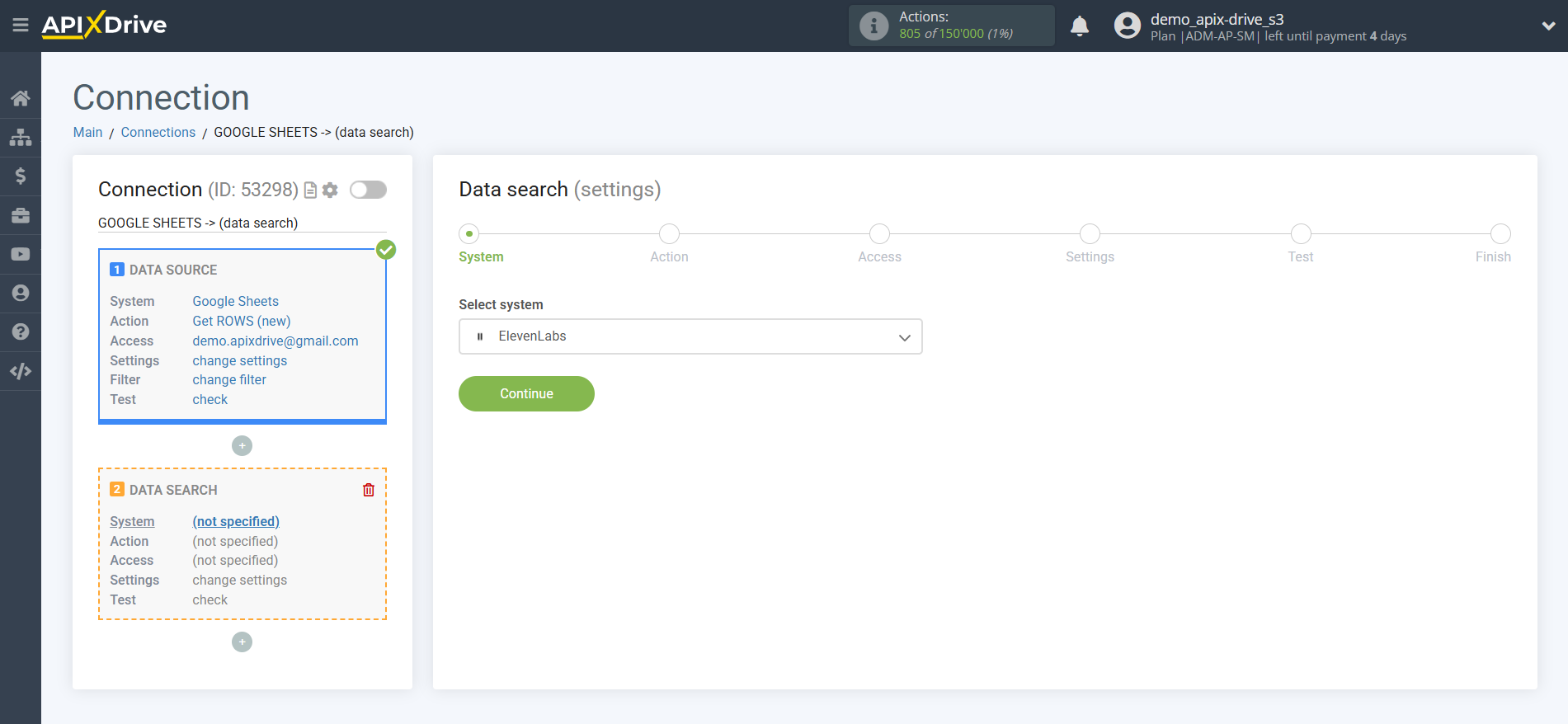
Next, select the action "Convert TEXT to SPEECH".
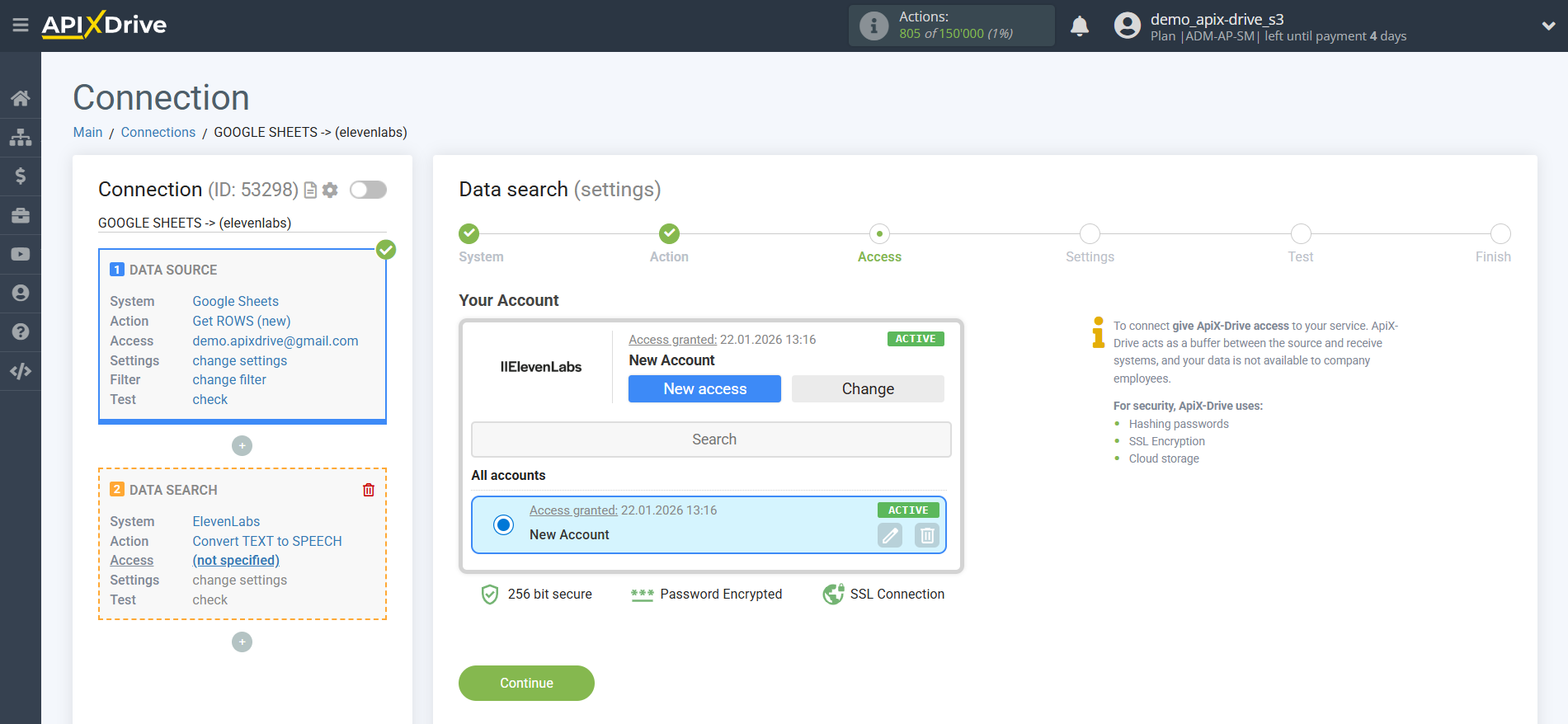
The next step is to select an Elevenlabs account.
If there are no accounts connected to the ApiX-Drive system, click "Connect account".
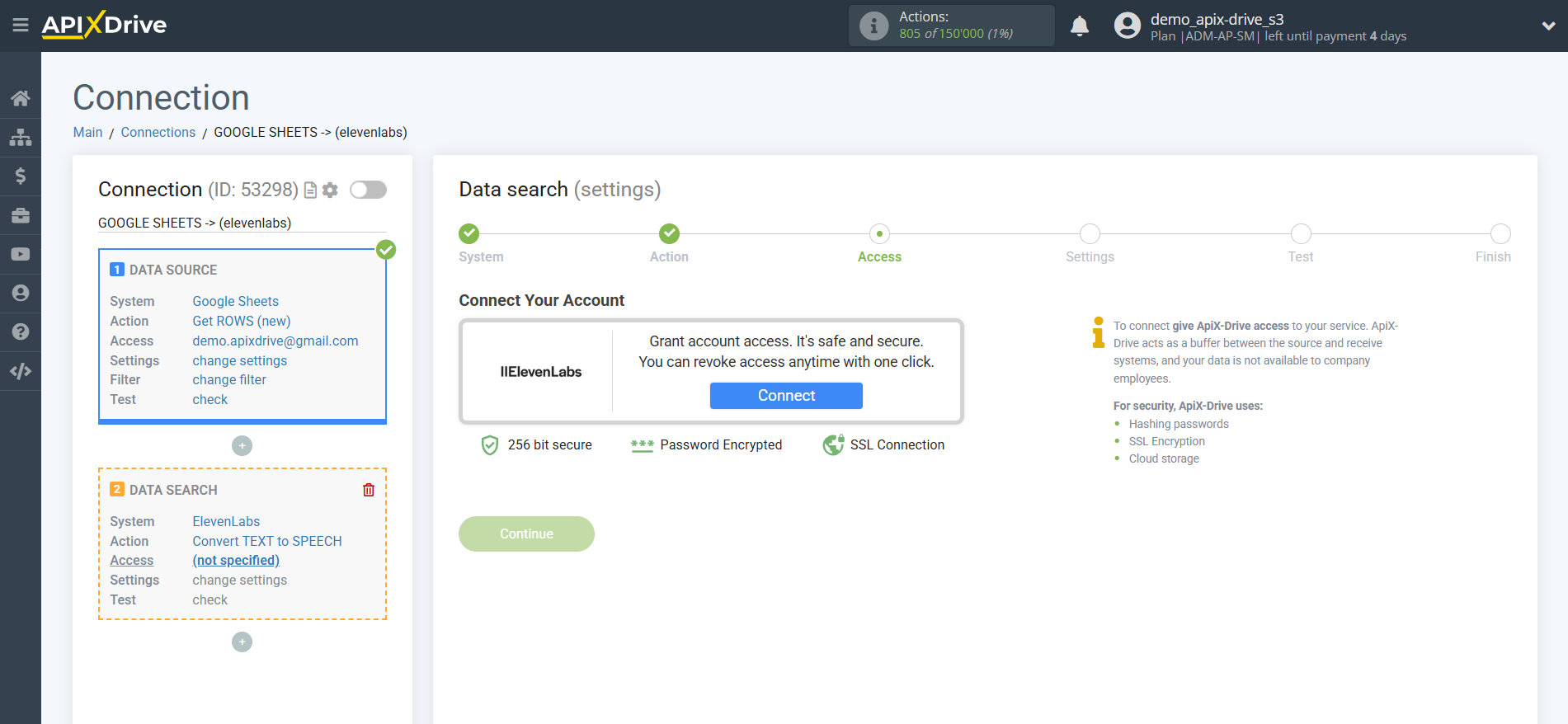
To connect your ElevenLabs account, you need to enter your API key.
To obtain an API key, go to your ElevenLabs account, open the Developers section, go to the API Keys tab, and generate a new key, granting it Full Access. Then, paste the generated API key into the corresponding field in ApiX-Drive and click "Save" to connect.
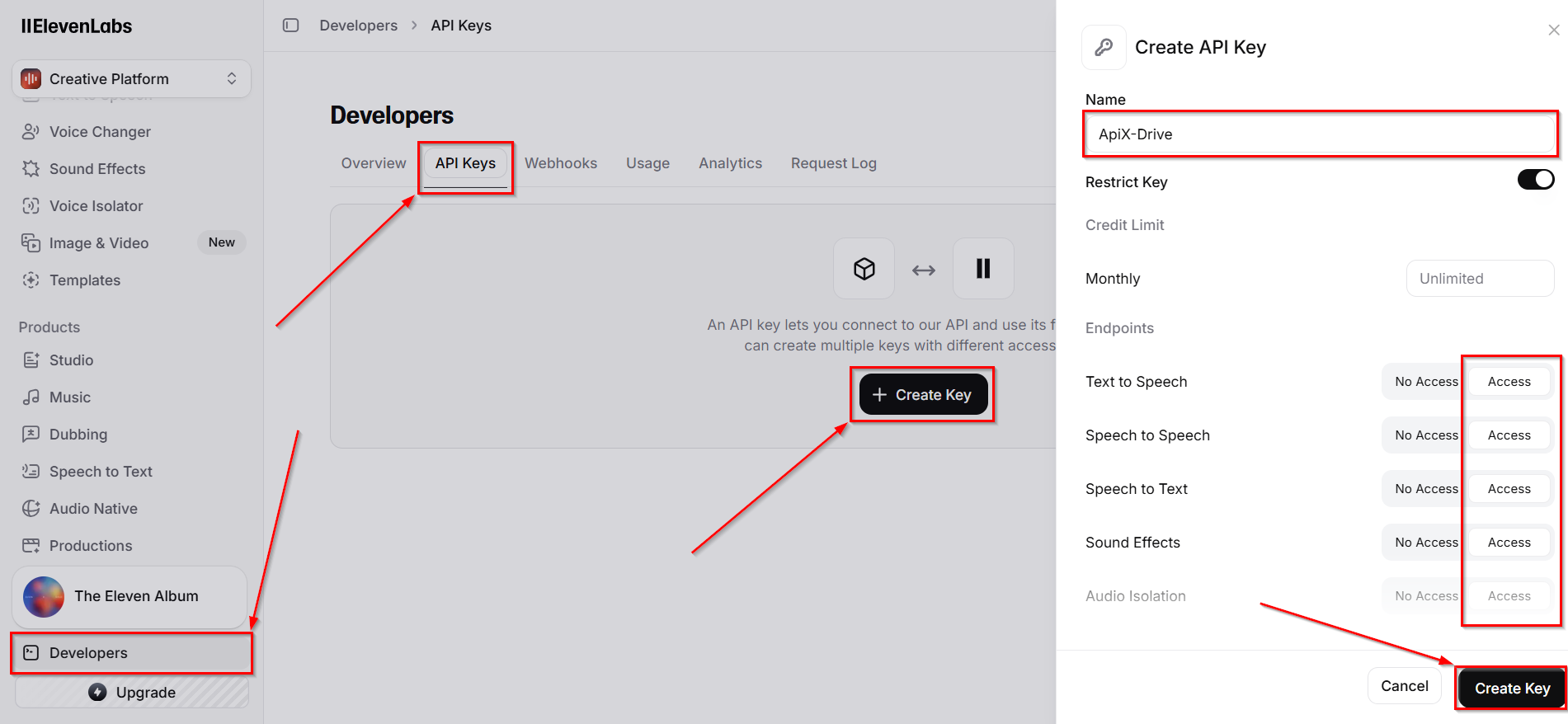
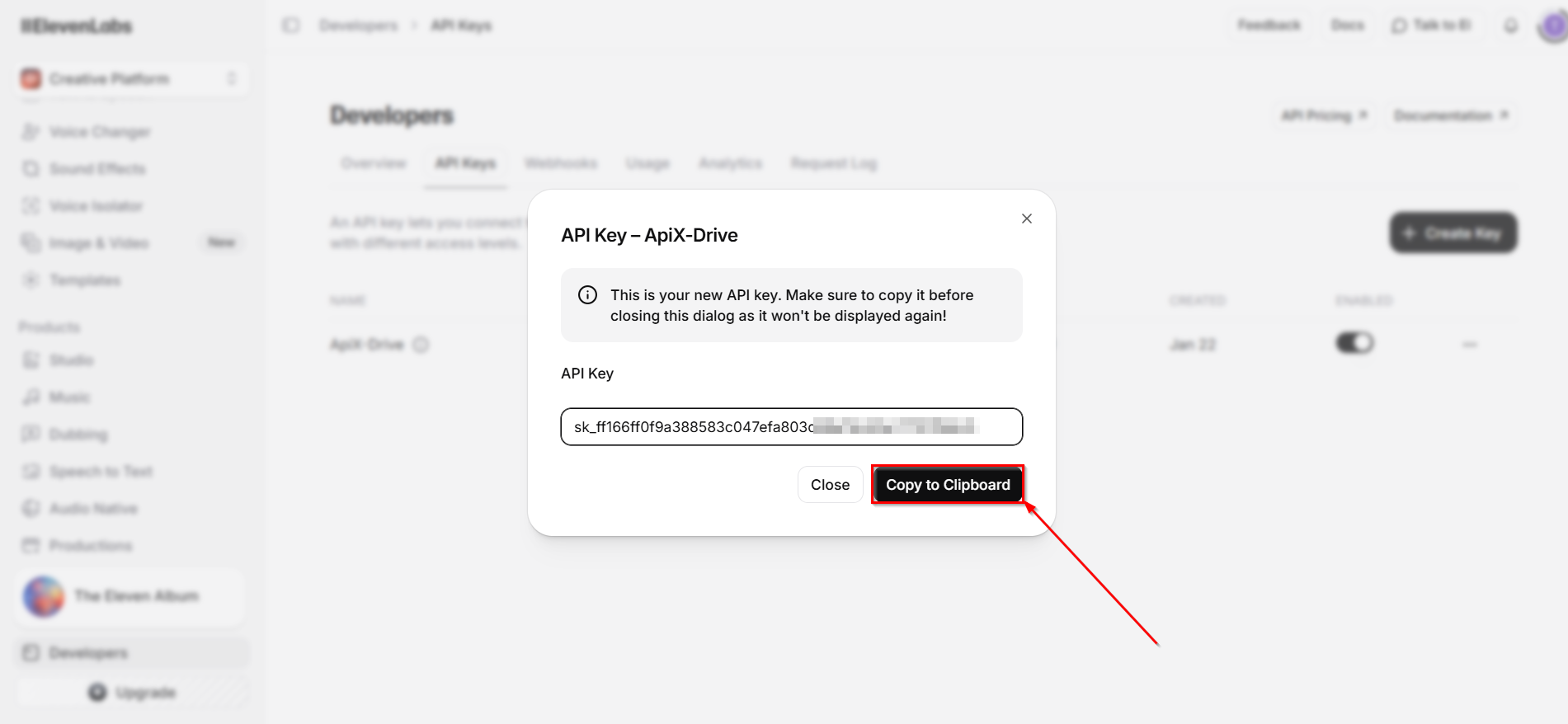
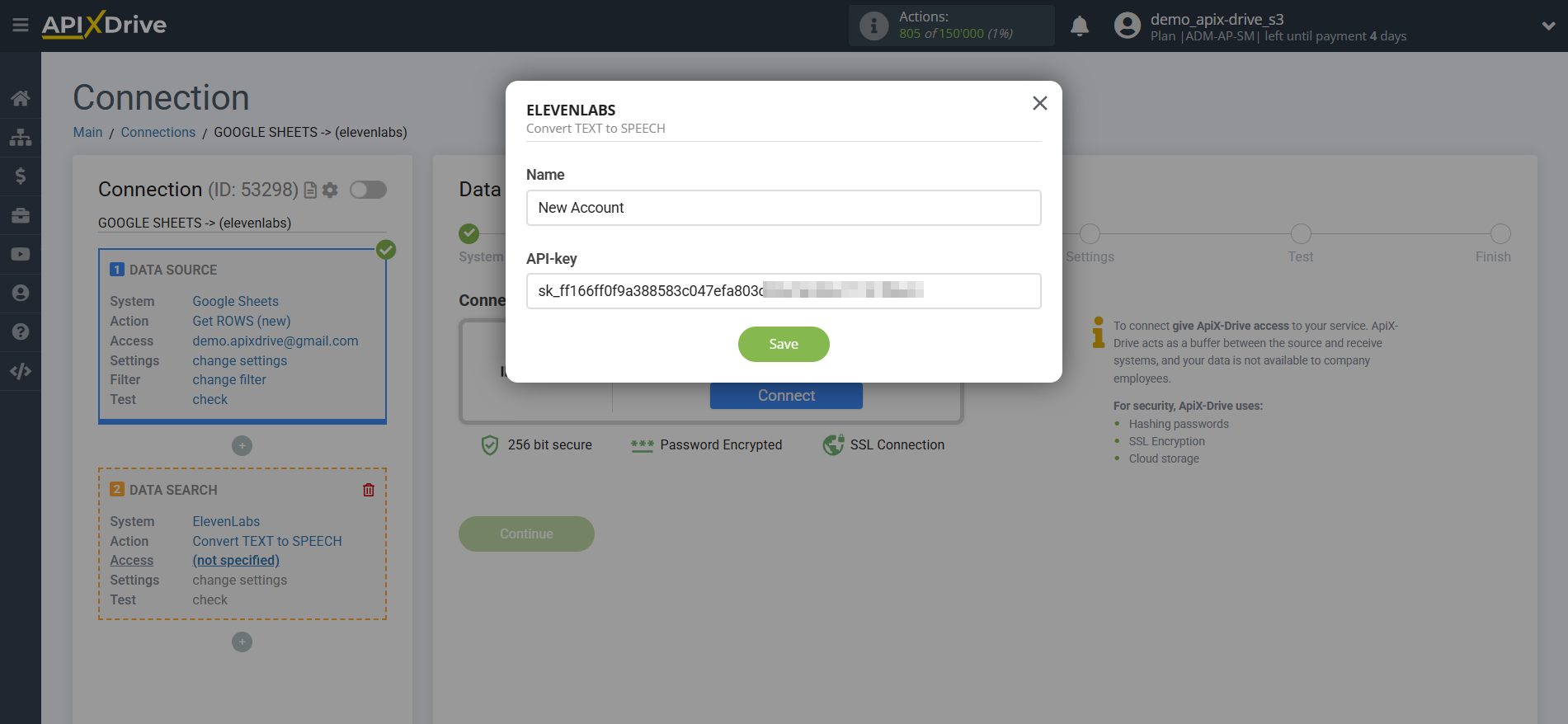
When the connected account appears in the "active accounts" list, select it for further work.
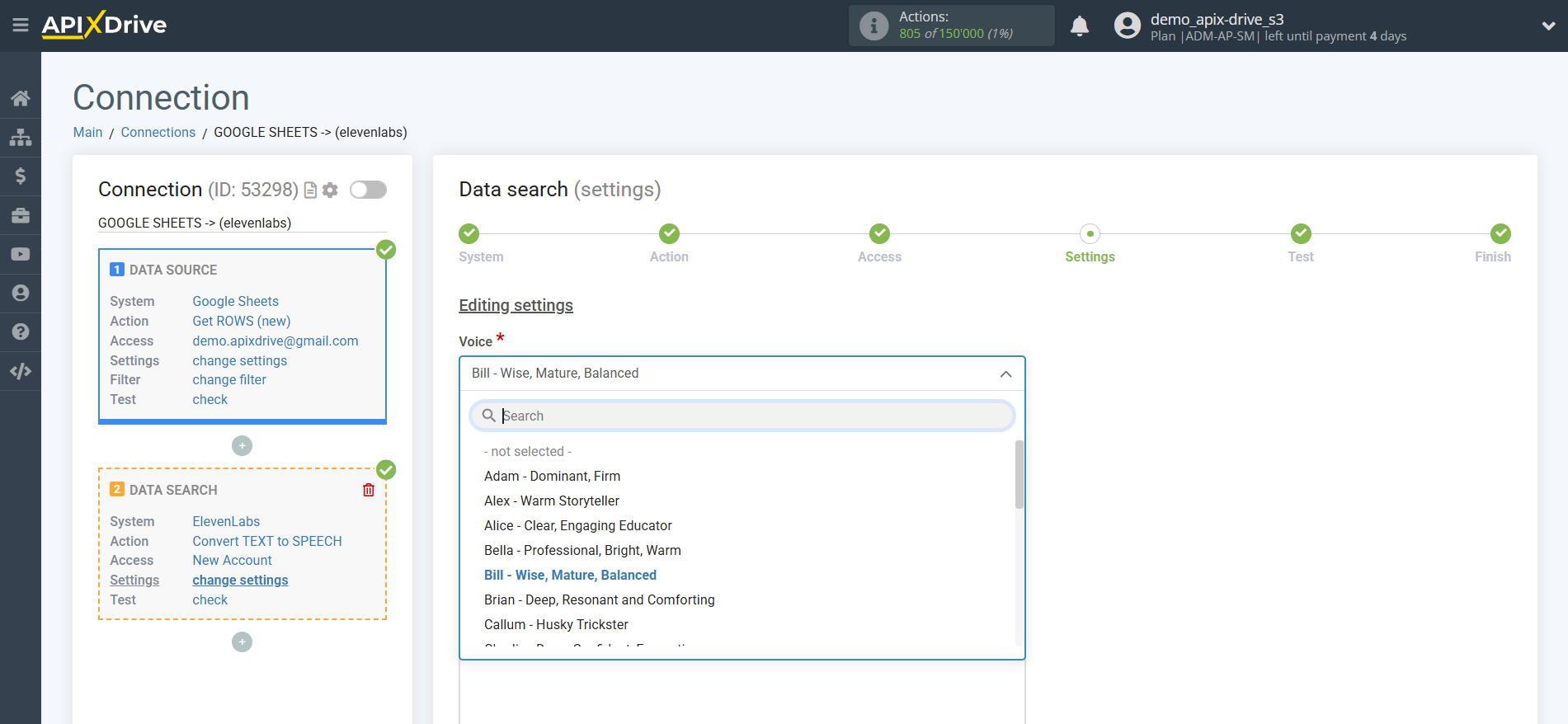
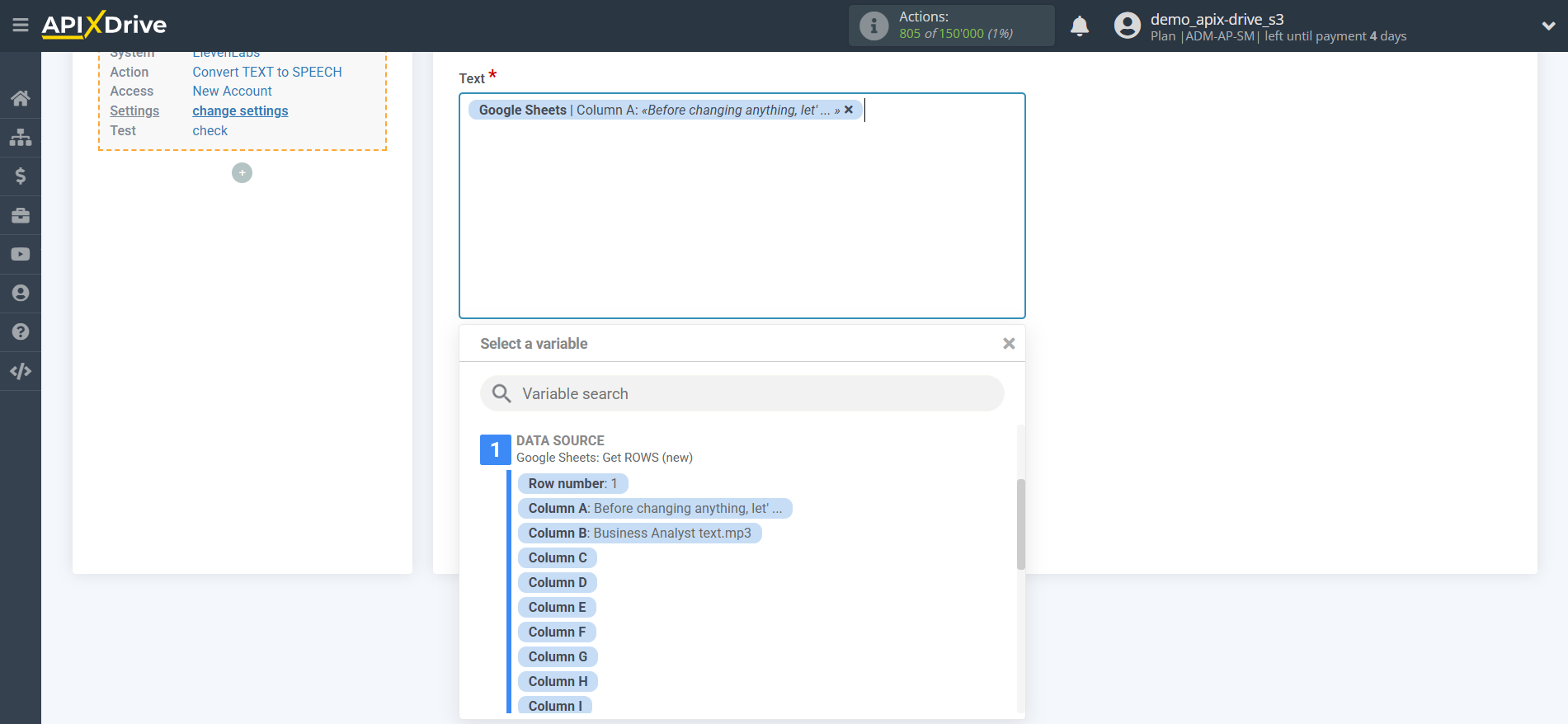
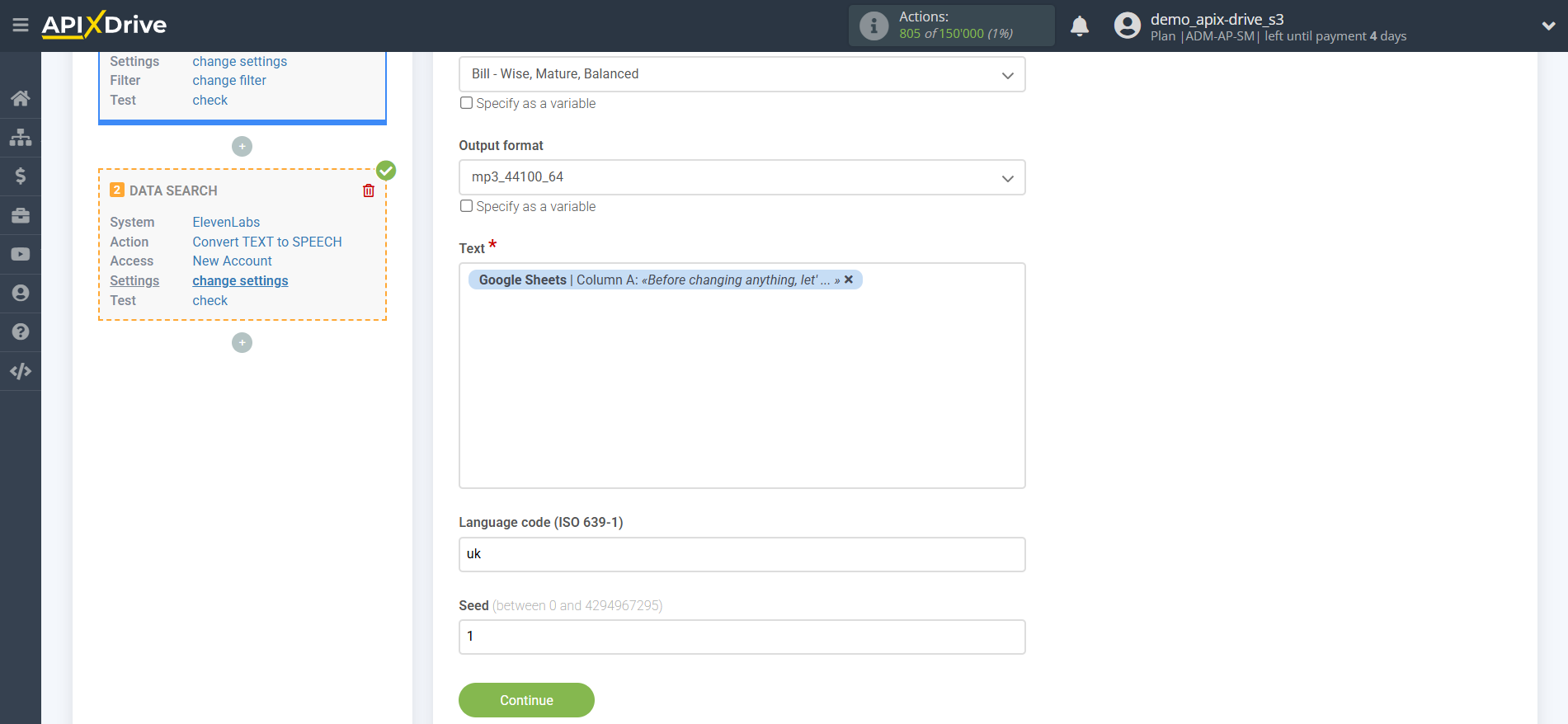
Next, you need to specify the text for the voiceover transferred from the Data Source block, as well as select the voice and format of the source audio file. If necessary, you can further customize other voiceover settings, including language and playback speed.
Now you can see the test data for the text-to-speech conversion result. This data can be passed to the Data Destination.
If the test data does not appear automatically, click "Search Elevenlabs".
If you're not satisfied with something, click "Edit," go back a step, and change the search field settings.
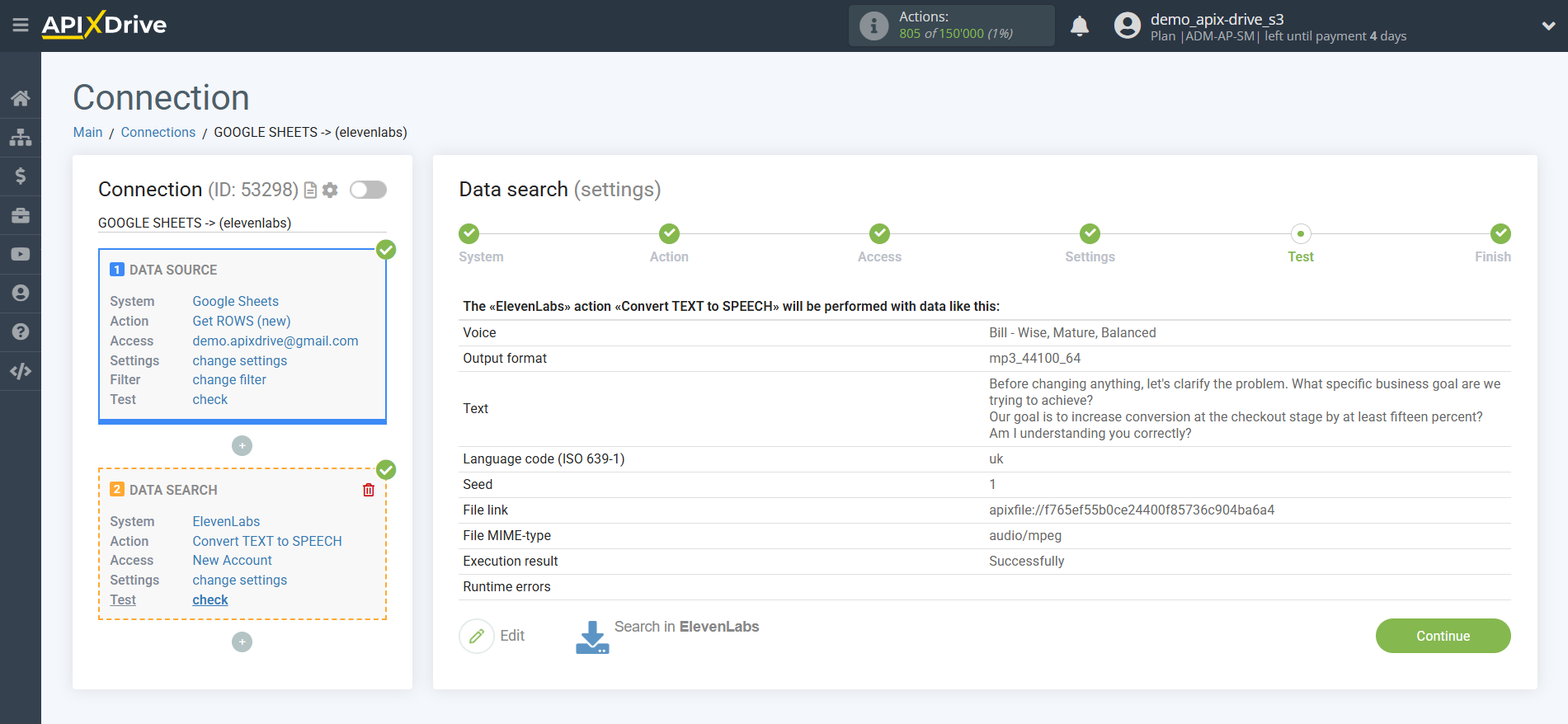
This completes the Data Search setup!
Now we can begin setting up Box as a Data Destination system.
To do this, click "Add Data DESTINATION".
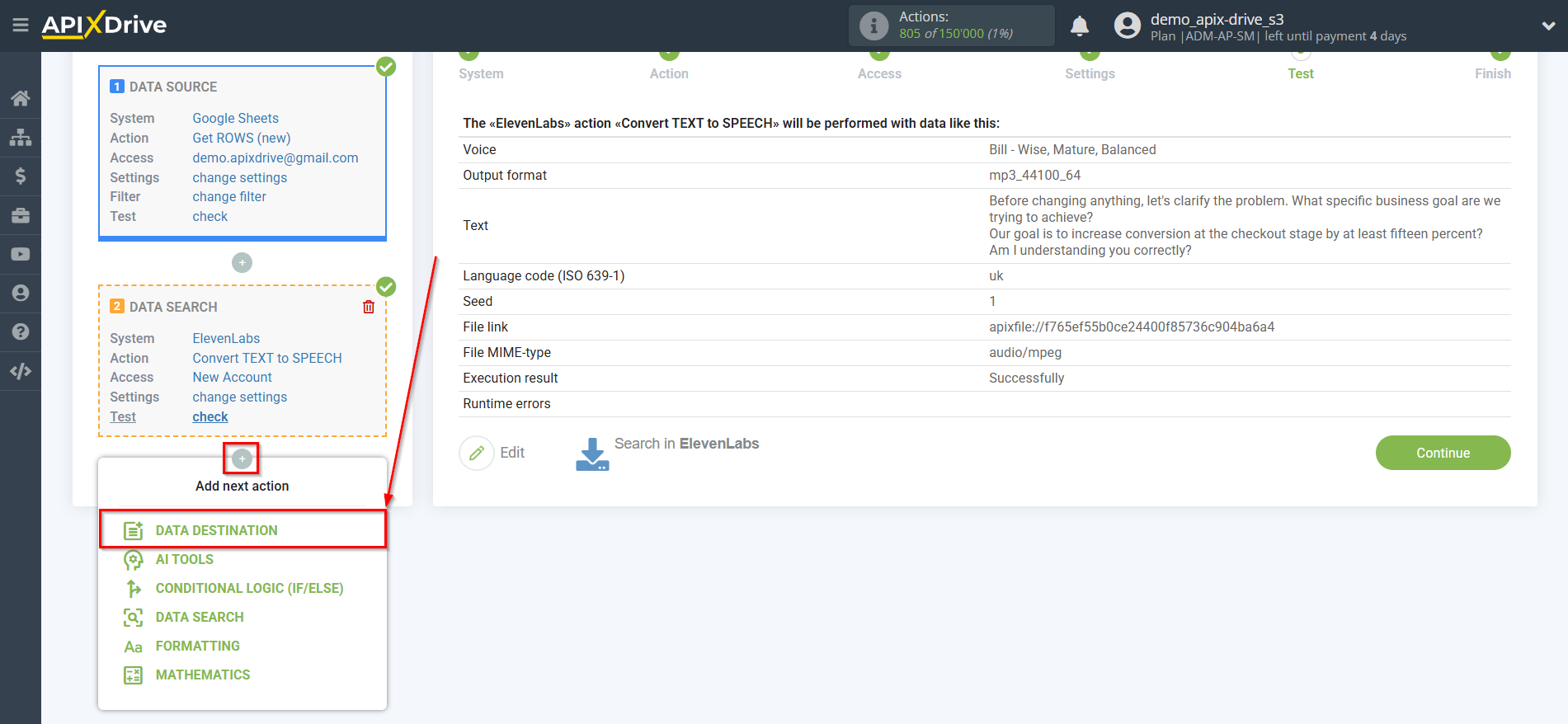
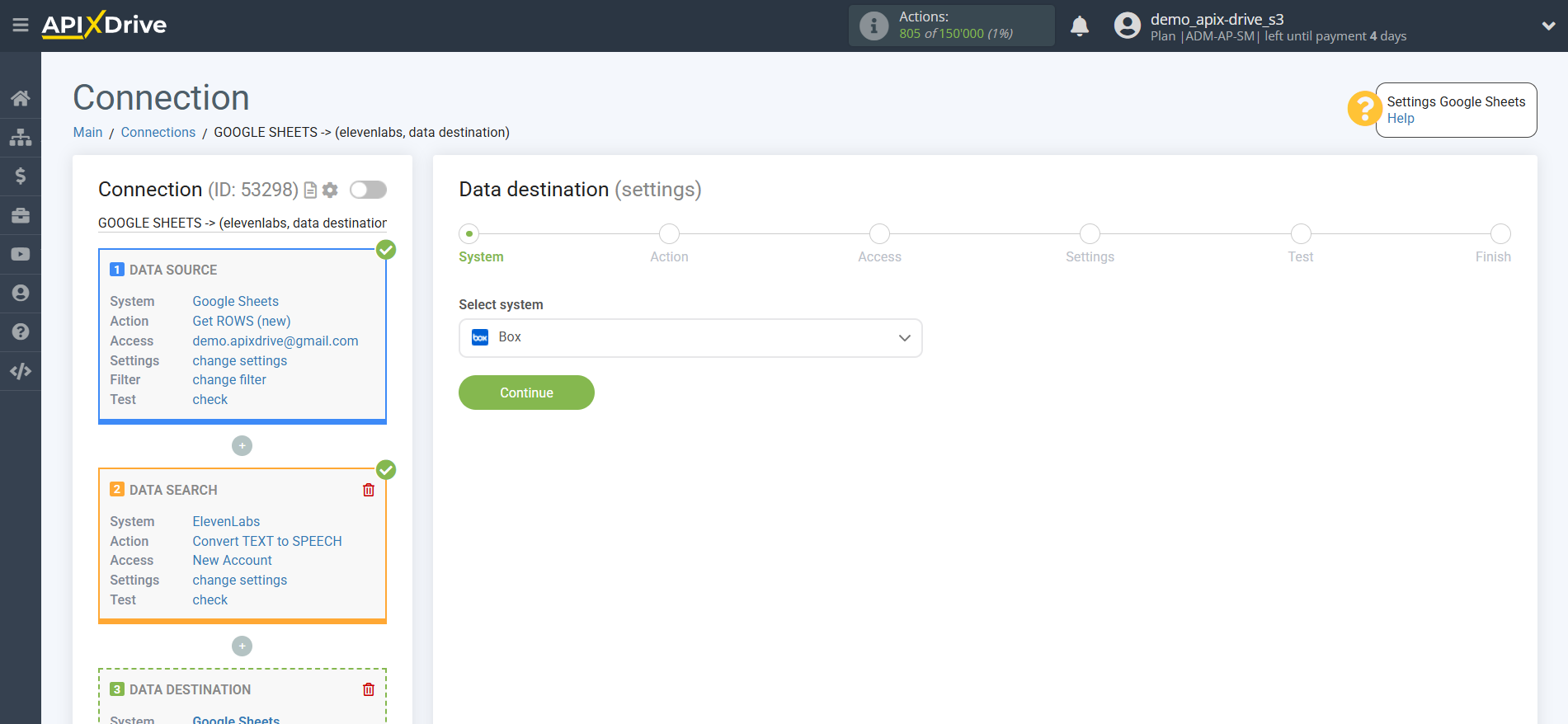
Setup Data Destination system: Box
Select a system as the Data Destination. In this case, you should select Box.
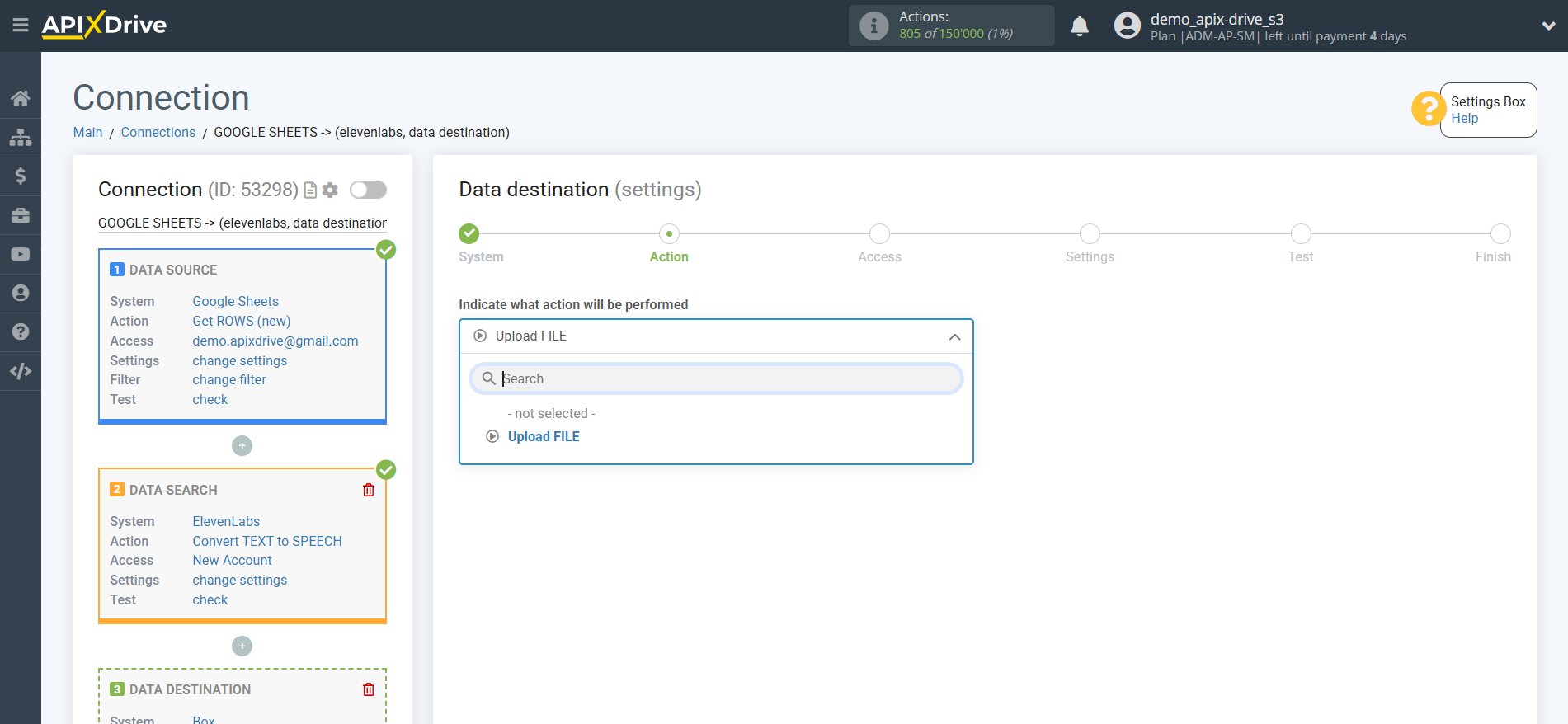
Next, you need to specify the action "Upload FILE".
The next step is to select the Box account to which the file from Elevenlabs will be transferred.
If there are no accounts connected to the ApiX-Drive system, click the "Connect account" button.
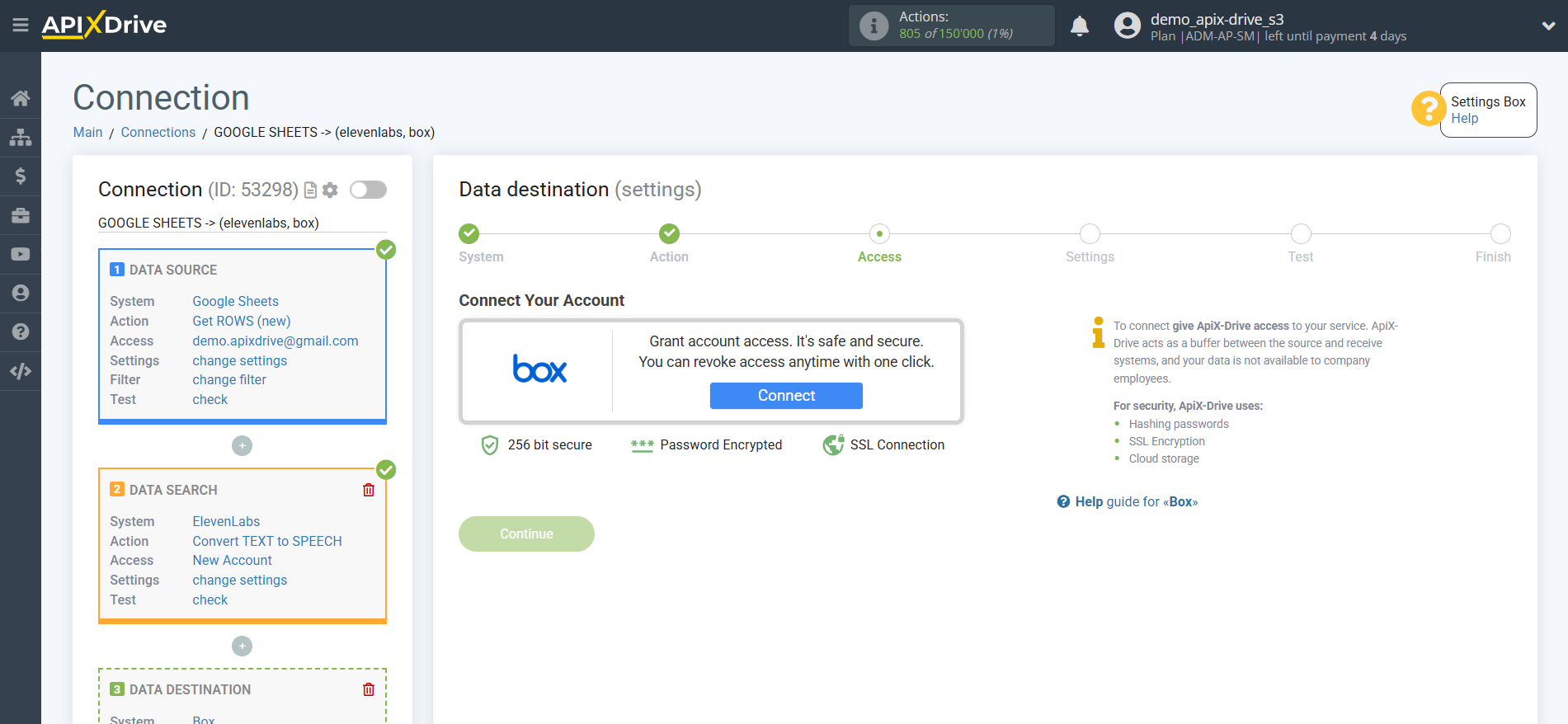
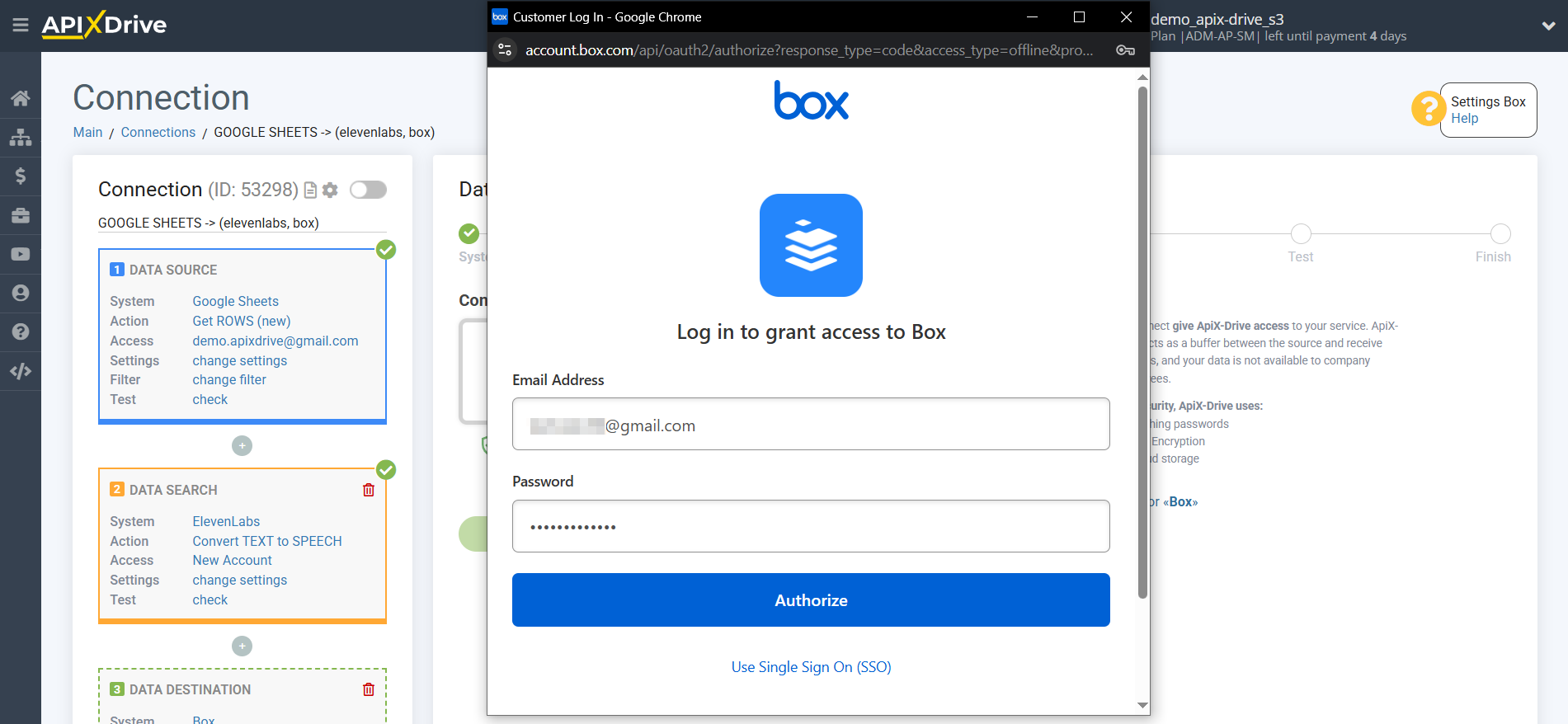
Enter your login details for your Box account and grant all connection permissions.
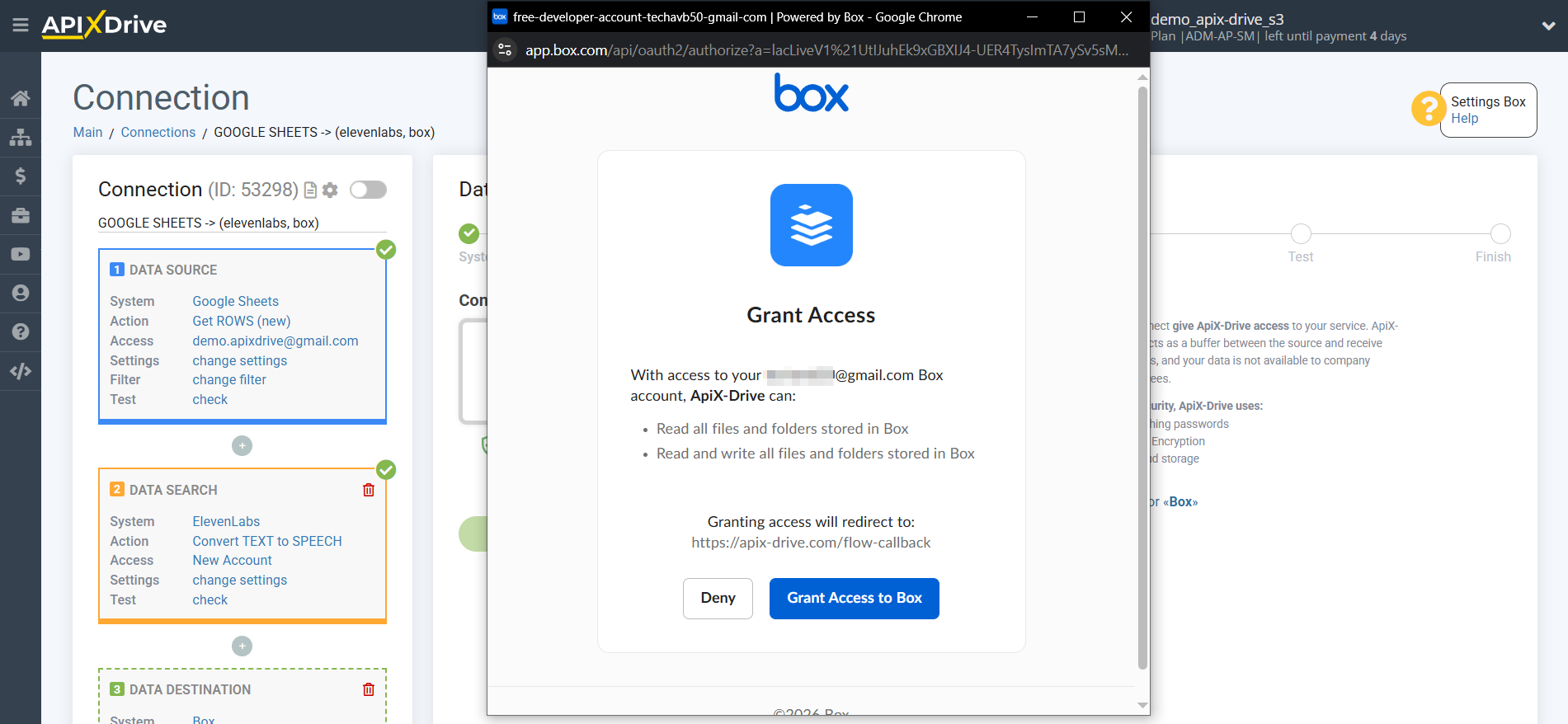
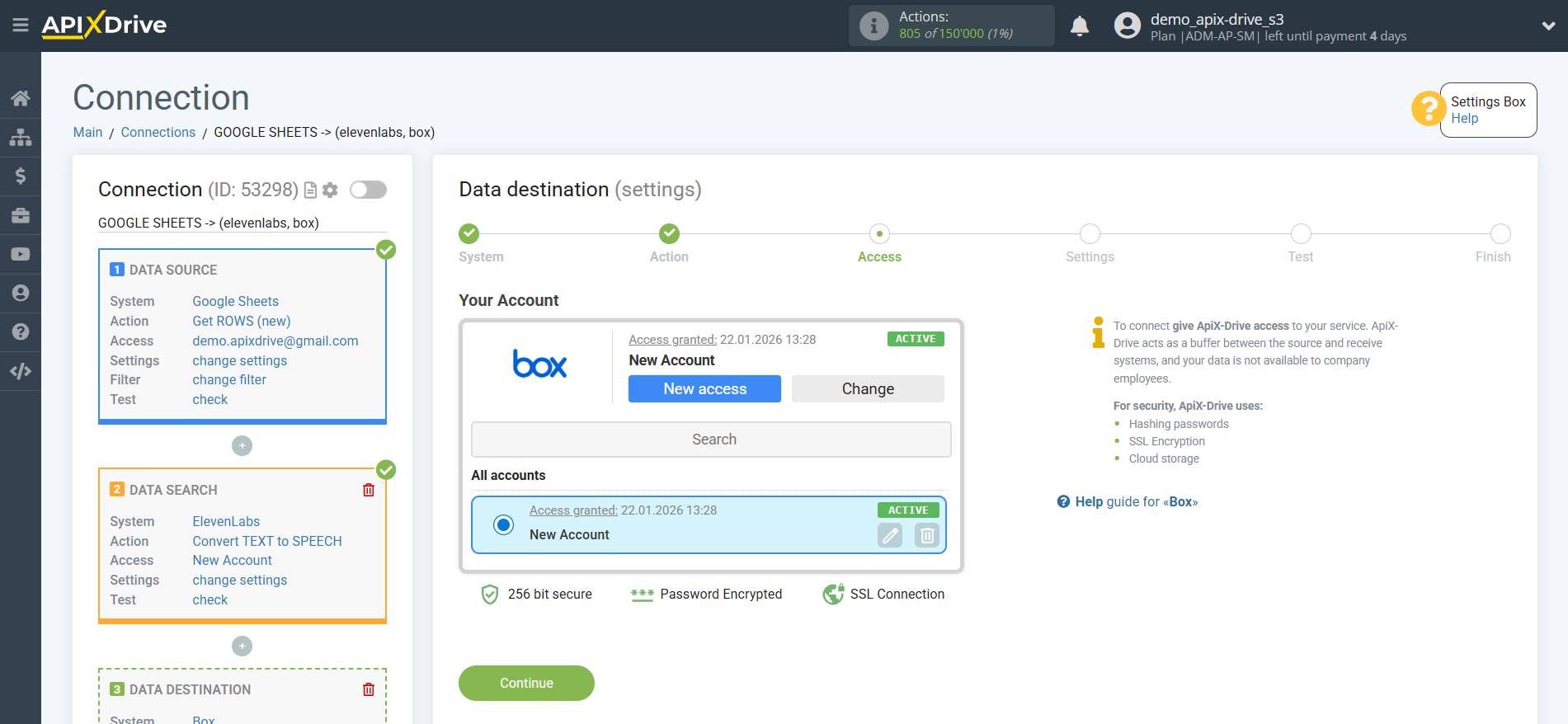
Once the connected account appears in the list of active accounts, select it for further work.
Now you need to specify the folder in your Box system where the file will be transferred after converting text to speech using ElevenLabs.
In the File Name field, enter the file name you want to save it under in Box. Enter a file extension (e.g., .mp3 or .wav) so the system knows the file type.
The file name can be taken from the Data Source. In this case, a dynamic variable will be used, and the file name will automatically change according to the values in the Source. This allows for automatic generation of unique file names for each processed text.
You also need to provide a link to the generated file obtained from the Search block after text-to-speech processing. This will allow files to be automatically uploaded to Box.
After setting up, click "Continue".
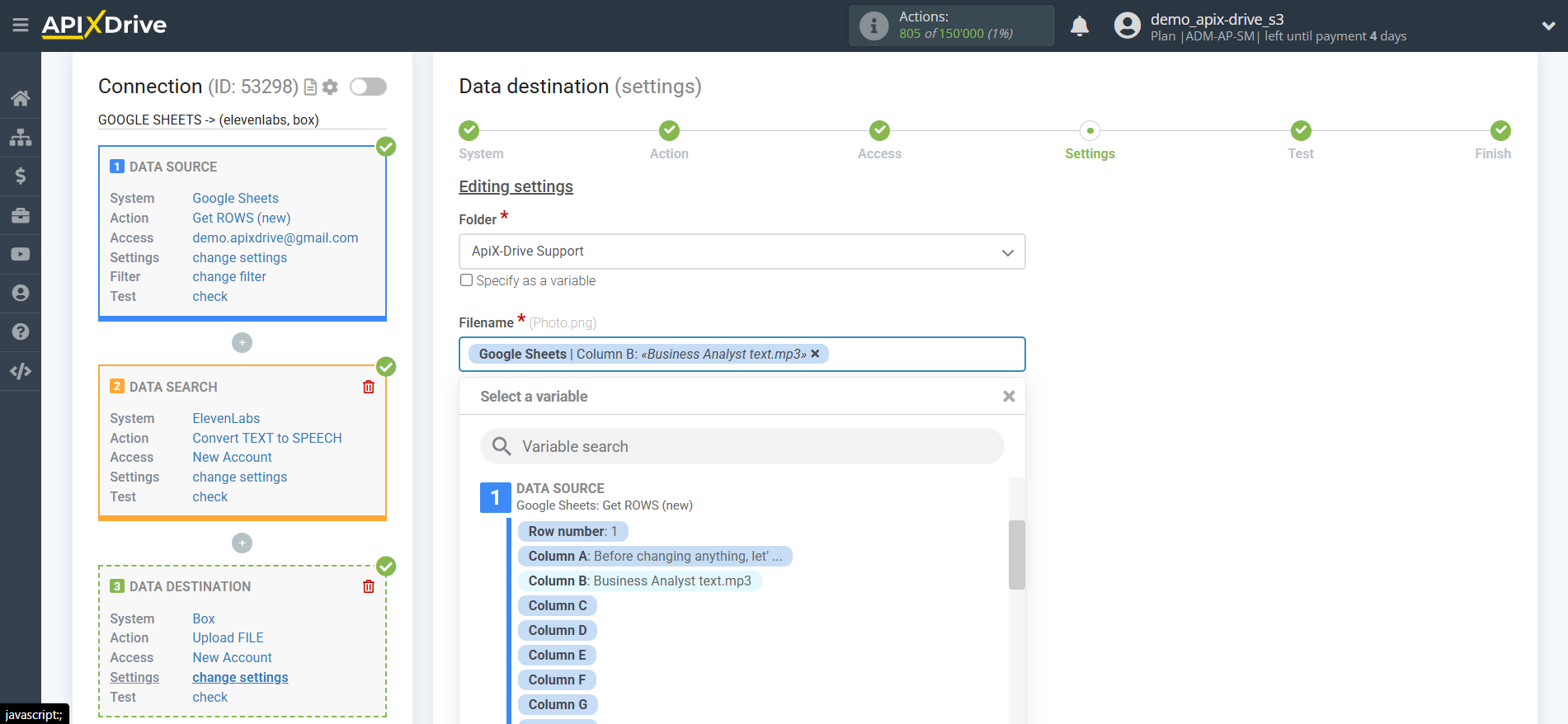
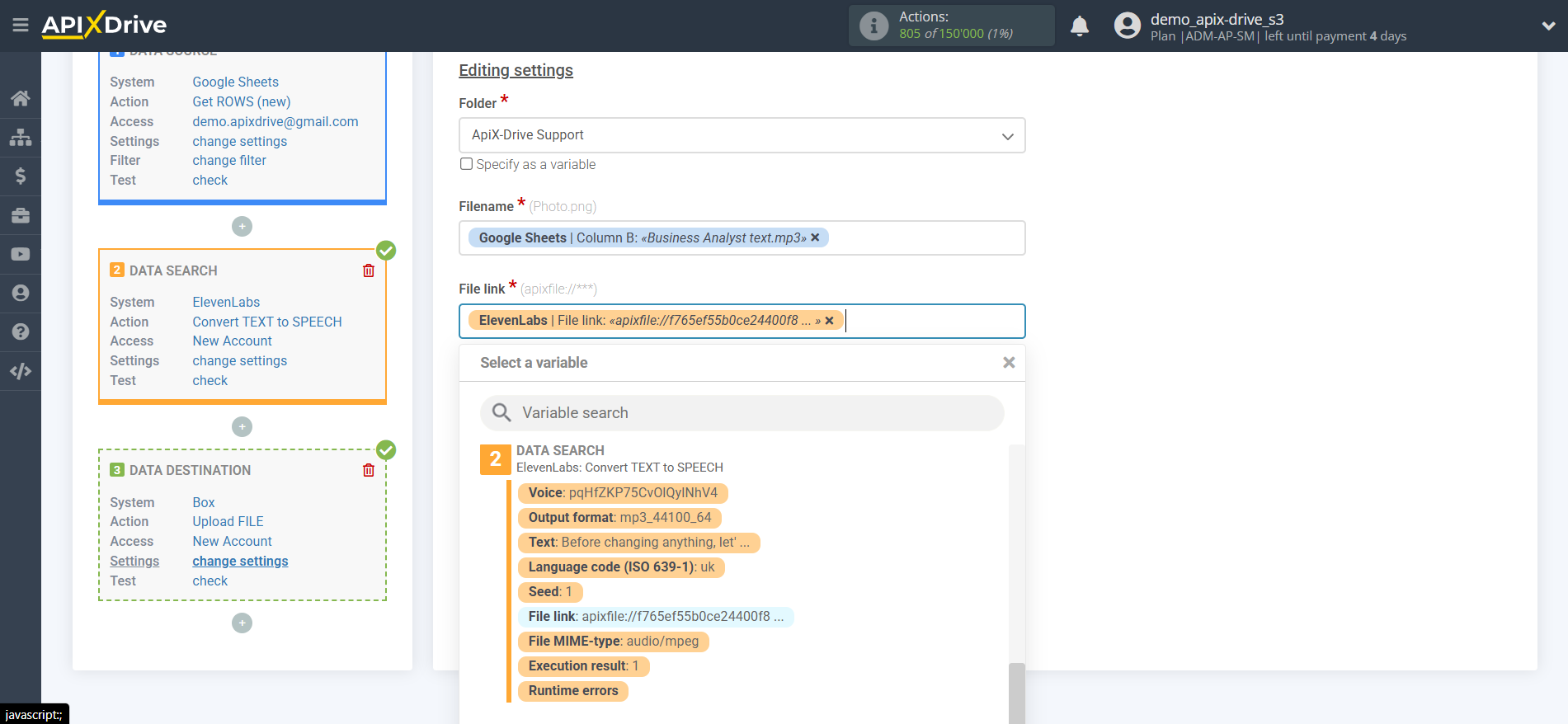
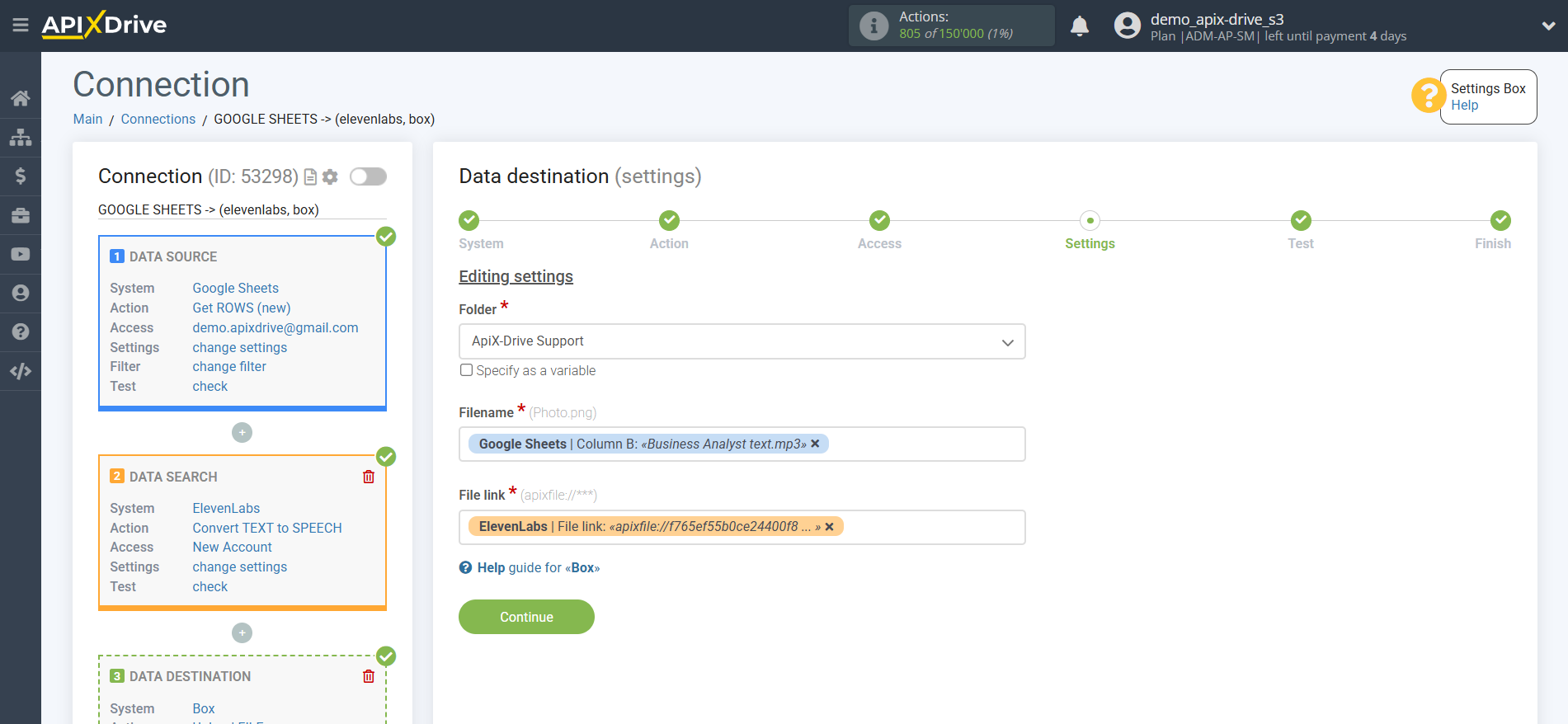
Thus, the Data Search block takes the field in the Data Source that contains the text to be converted to speech, sends it to ElevenLabs for processing, receives the generated file, and then transfers this file to the Data Destination field, for example, to a selected folder in Box.
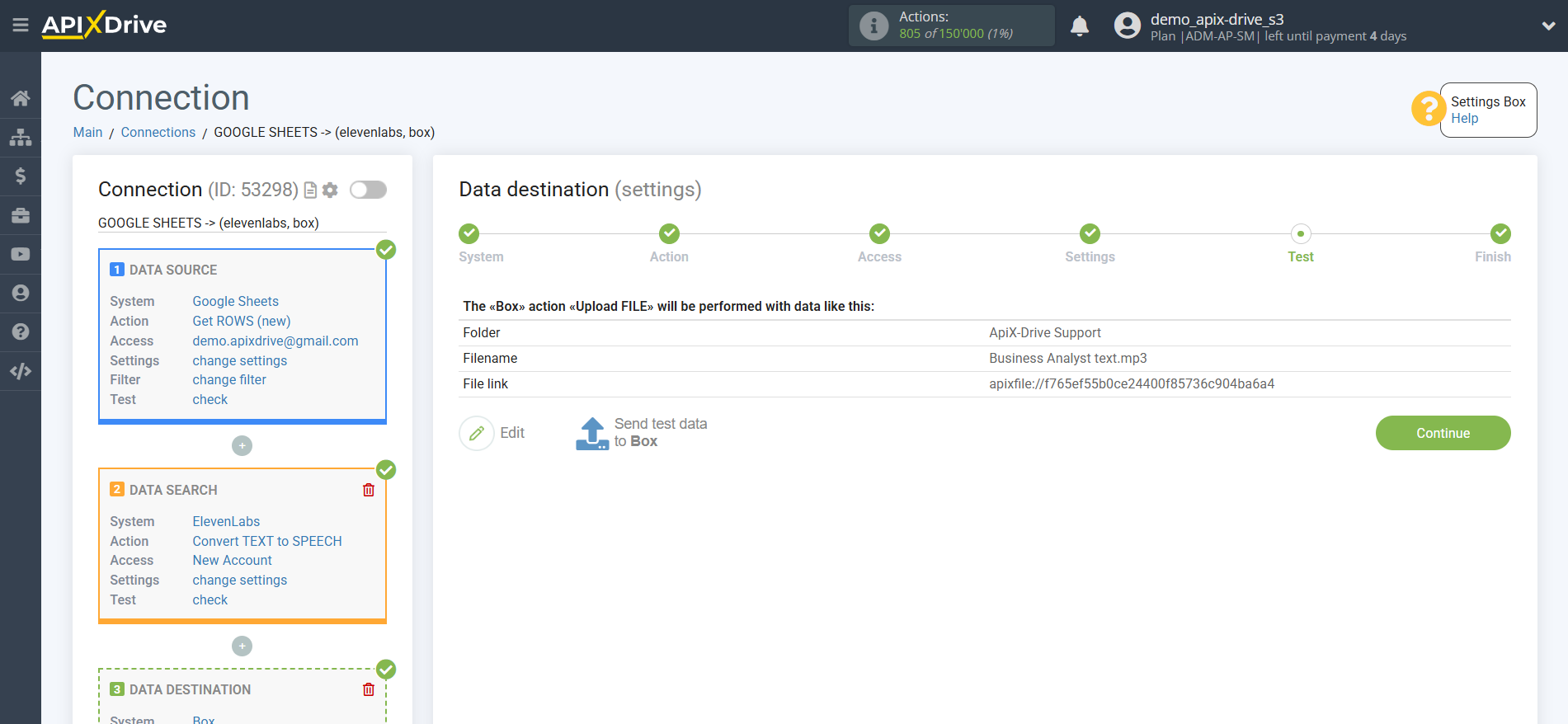
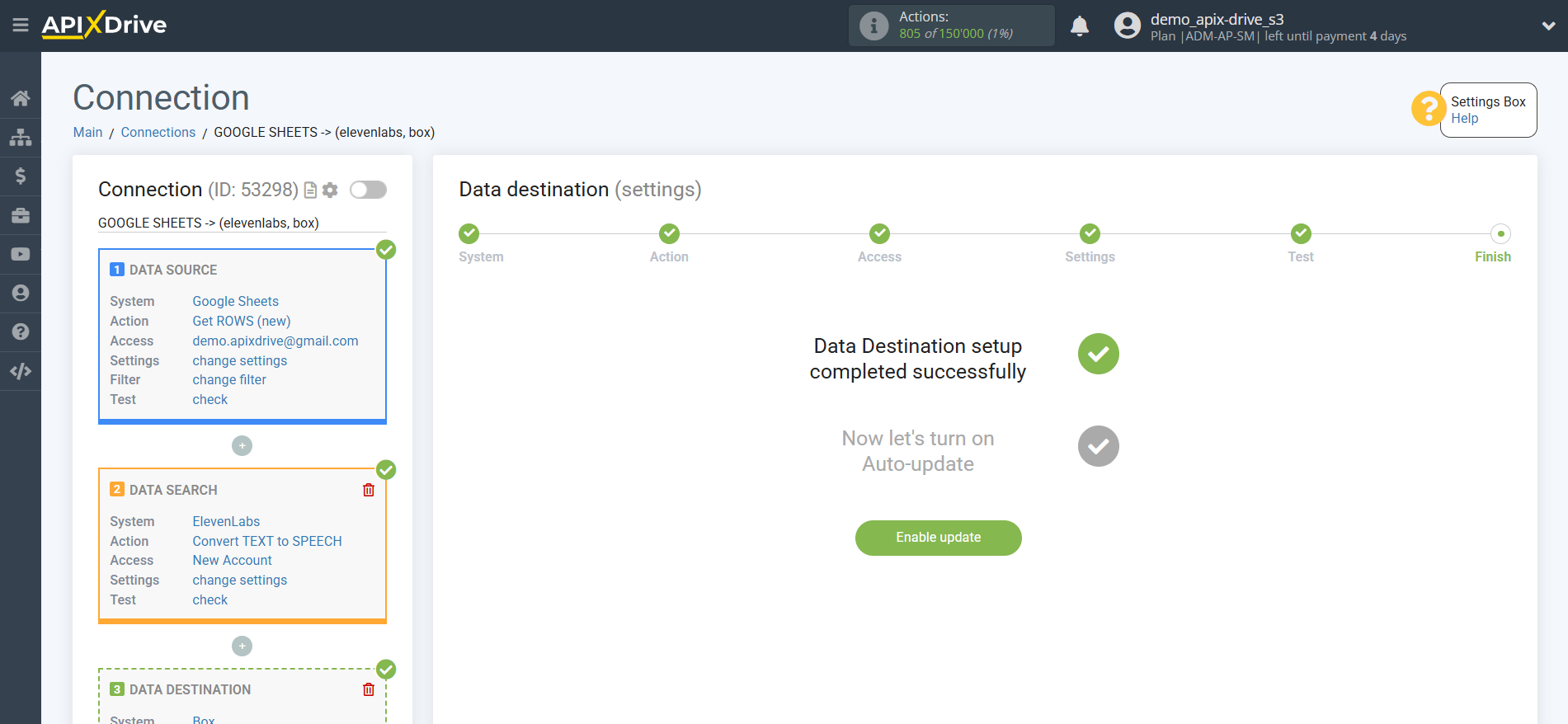
This completes the Data Destination system setup!
Now you can start choosing the update interval and enabling auto-update.
To do this, click "Enable update".
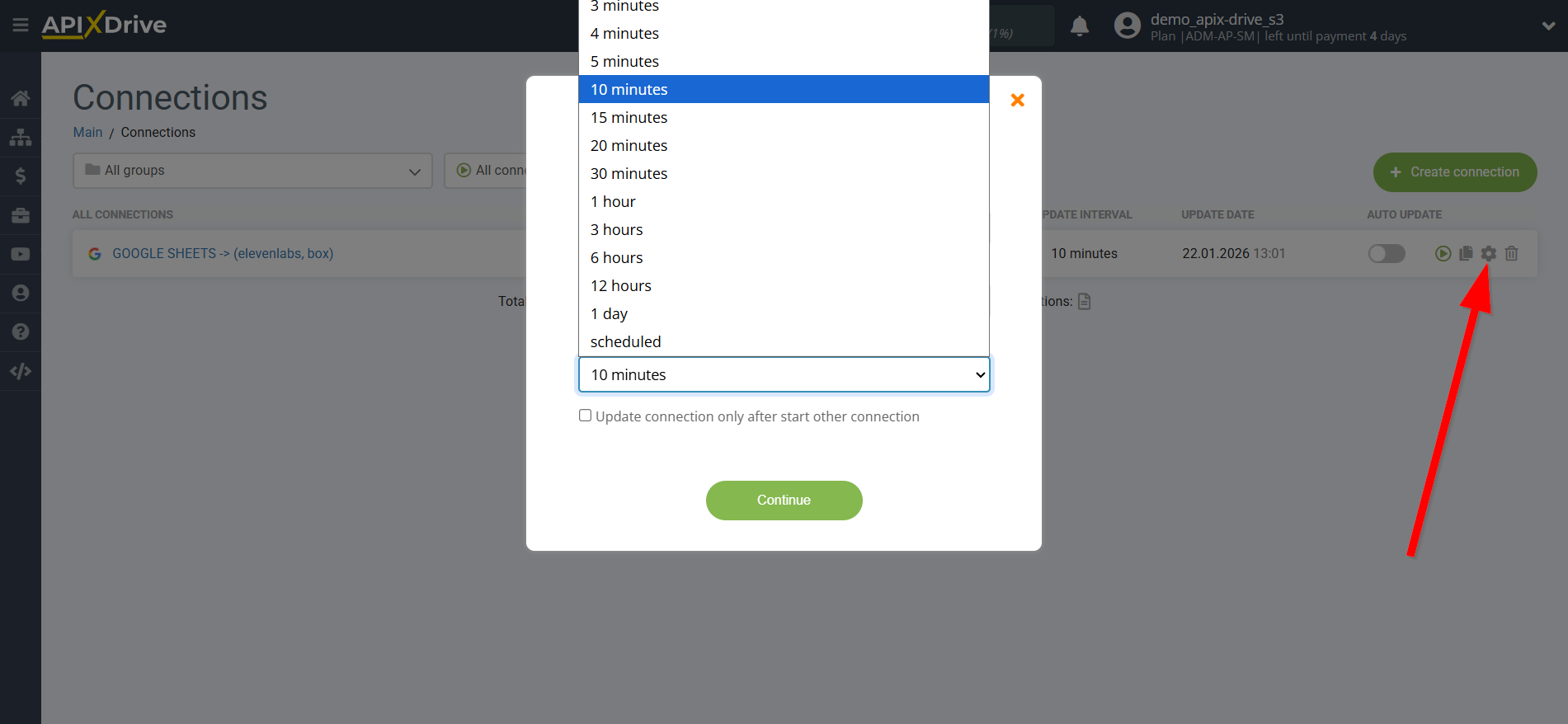
On the main screen, click on the gear icon to select the required update interval or set up scheduled launch. To start the connection by time, select scheduled start and specify the desired time for the connection update to be triggered, or add several options at once when you need the connection to be triggered.
Attention! In order for the scheduled run to work at the specified time, the interval between the current time and the specified time must be more than 5 minutes. For example, you select the time 12:10 and the current time is 12:08 - in this case, the automatic update of the connection will occur at 12:10 the next day. If you select the time 12:20 and the current time is 12:13 - the auto-update of the connection will work today and then every day at 12:20.
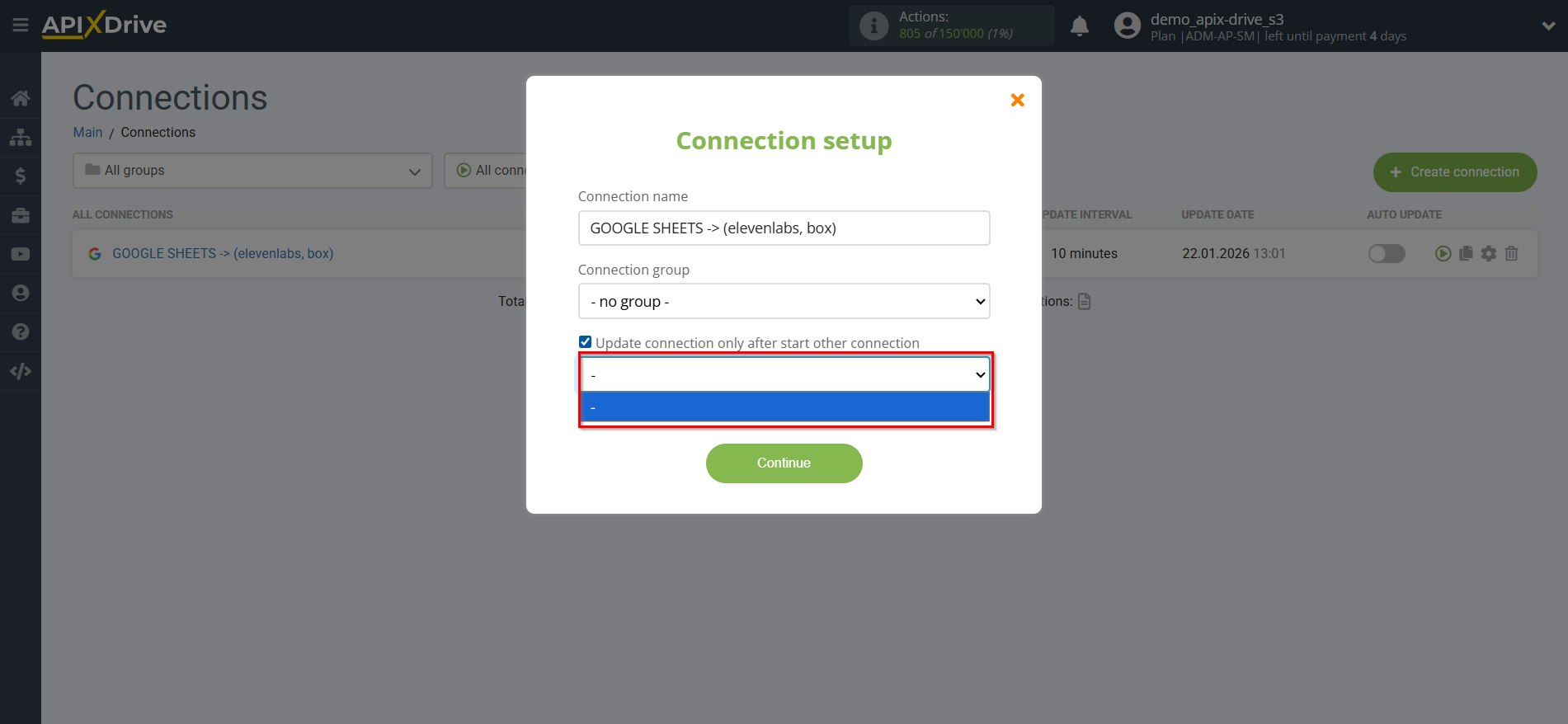
To make the current connection transmit data only after another connection, check the box "Update connection only after start other connection" and specify the connection after which the current connection will be started.
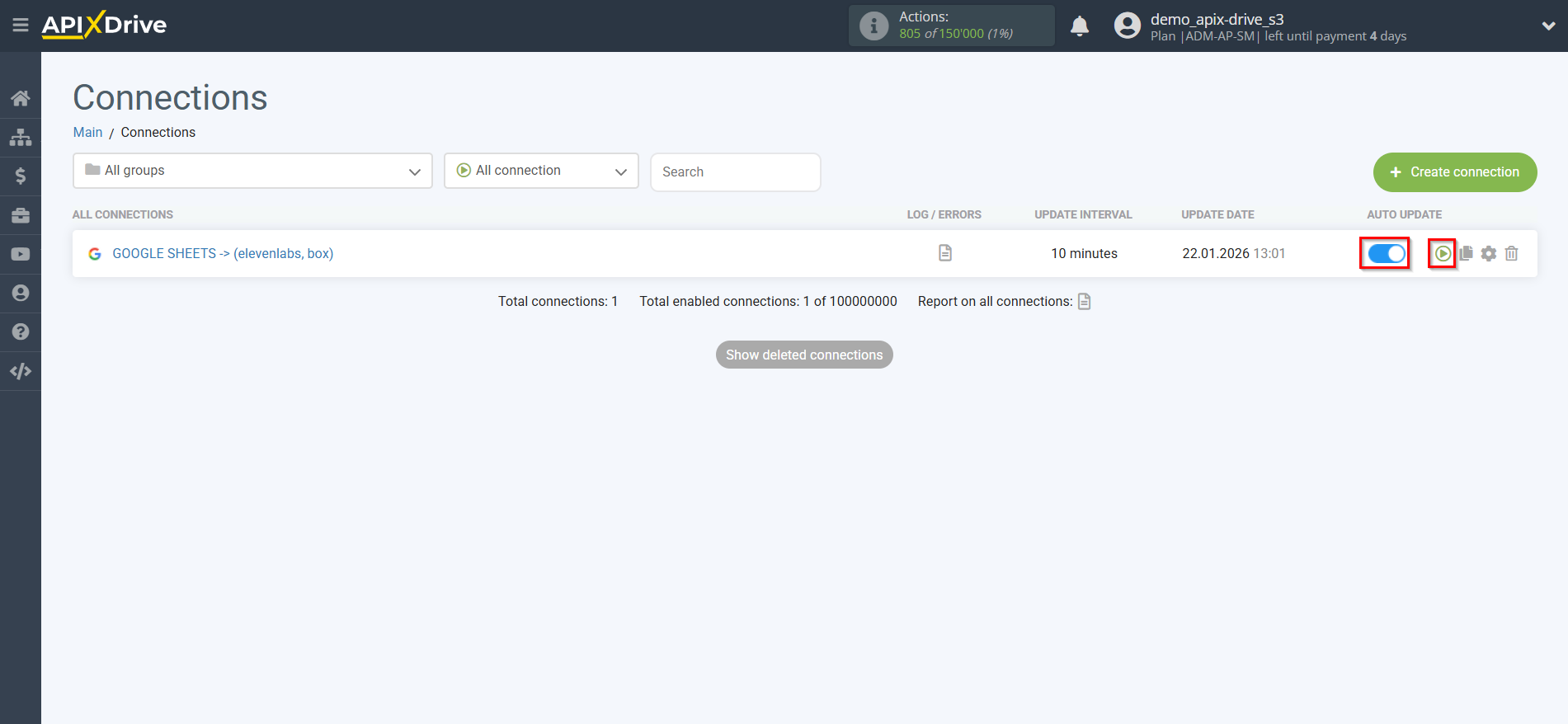
To enable auto-update, switch the slider to the position shown in the picture.
To force the connection, click on the arrow icon.
That's it, setting up Elevenlabs Data Search is complete!
See how easy it is!?
Now don't worry, ApiX-Drive will do everything on its own!